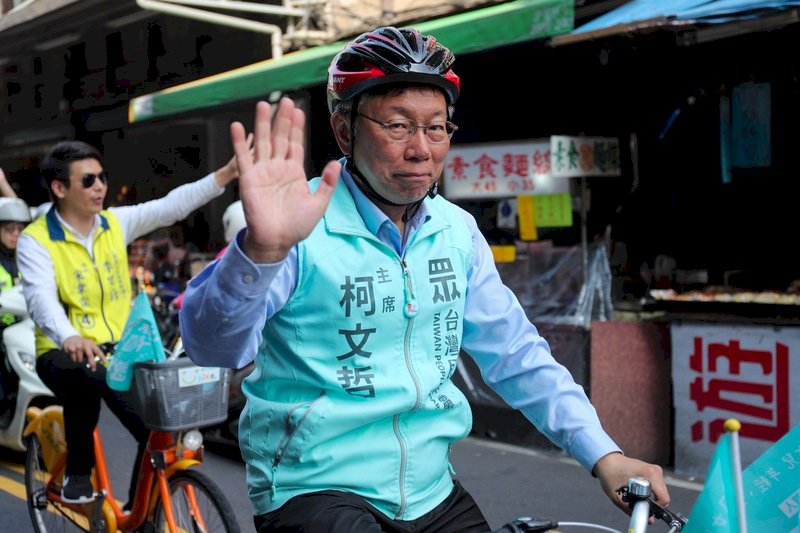
This year, in addition to the DPP, the KMT and the PFP, 16 other small political parties are vying for the legislative seats. Today we look at three of those parties which have been in the headlines: Taiwan People’s Party, Formosa Alliance, and New Power Party.
The Taiwan People’s Party (TPP) is one of Taiwan’s newest parties…Taipei Mayor Ko Wen-je founded it last August. The outspoken mayor said the TPP will prioritize things that benefit all of Taiwan and the well-being of the people. On the diplomatic front, the party calls for a pragmatic approach to ensure Taiwan’s survival and sovereignty. As of last October, the party had less than 6,000 members.
Ko, a surgeon-turned-politician, received support from the DPP during his run for Taipei Mayor in 2014. But his relations with the DPP have soured in recent years, partly due to his stinging criticism of the DPP government’s policies and his decision to run for re-election as Taipei mayor against a DPP candidate in 2018. It is expected that his party – the TPP -- will shake up Taiwan’s political landscape, which has long been dominated by the DPP and the KMT.
The Formosa Alliance is a political coalition that was restructured as a political party last July. That’s after a pro-independence group split off from the Democratic Progressive Party in 2018. The Formosa Alliance is calling for a referendum on Taiwan independence and is pushing the idea of re-entering the United Nations under the name “Taiwan,” instead of the country’s formal name: the “Republic of China.” The party is anti-communist, particularly in light of the threat posed by China against Taiwan.
Last September, former Vice President Annette Lu, a DPP member, announced her decision to run for president as an independent backed by the Formosa Alliance. Lu, however, withdrew from the race two months later after failing to gather the required number of signatures.
And finally, the New Power Party (NPP) was founded in January 2015. Later that year, the party elected Huang Kuo-chang, a legal scholar known for his lucid political discourse, as its chairperson. A year later, in the 2016 legislative elections, the NPP won an impressive five seats, making it the third largest political party after the DPP and the KMT.
But in 2019, the NPP faced its first crisis. An outspoken lawmaker who rose to fame as a heavy metal singer, Freddy Lim, withdrew from the party because he was unhappy with the NPP’s political stance. That’s because some party members support the TPP and others support the DPP. Now Lim is running for lawmaker as an independent and he openly supports the DPP’s President Tsai Ing-wen. Lim is not the only high profile figure to leave the party… another NPP lawmaker, Hung Tzu-yung, left less than two weeks later.