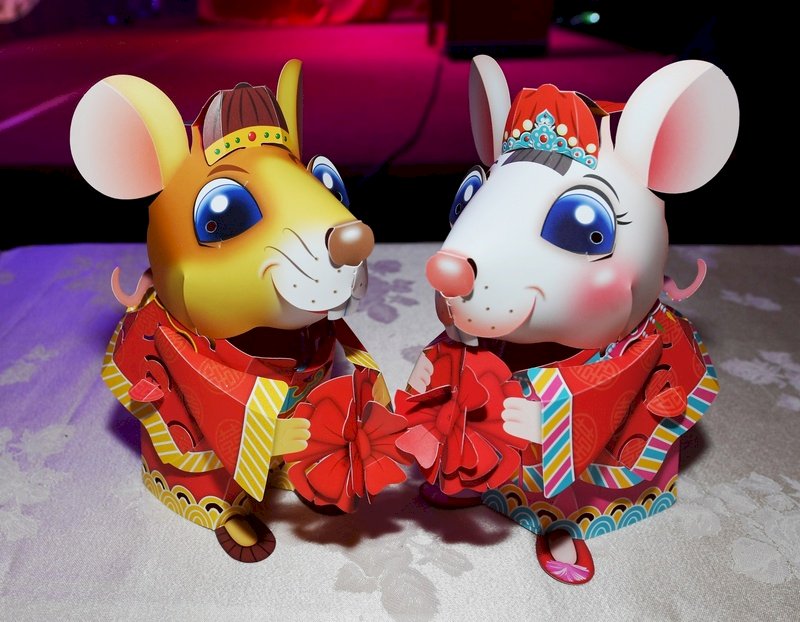
The Year of the Rat is the first year in the twelve-year cycle of the Chinese Zodiac. Why does the rat come first? Some cite Chinese legends. Others credit rats’ unique physical features, which make them stand out from the rest of the zodiac animals: they have four toes on their front feet and five toes on their back feet.
Whatever the case, the rat has a long-standing place in the cultural imagination of Chinese speakers. For instance, rats appear in the Book of Songs, the earliest Chinese anthology of songs and poetry, written between the 11th and 6th centuries BCE. In one passage, corrupt officials are referred to as “huge rats”. Rats still feature in everyday colloquial speech from time to time as well. One common saying goes lǎo shǔ guò jiē rén rén hǎn dǎ (老鼠過街人人喊打). This literally means “when a rat crosses the street, everyone shouts at it and beats it”. This is really just a colorful way of referring to public fury over someone’s unscrupulous behavior.
Rats are adept at hiding and scurrying. The Chinese phrase “smarter than a rat” is used to describe people who are “sly, agile, fast, shrewd, a bit too clever, and extremely protective of their own interests”. This phrase can carry either positive or negative connotations, depending on the context.
In Chinese culture, the rat is a symbol of robust vitality and a large family. That’s because they are profoundly prolific, producing more offspring than humans. However, because rats steal food, spread disease, and start fires by gnawing on electric cables, most Chinese phrases related to rats are completely negative.
For example, there are two phrases that make reference to the animal’s small eyes. One is shǔ mù cùn guāng (鼠目寸光). Literally, this means “the eyes of a rat can only see an inch of light”. The real meaning of the phrase is that people are short-sighted and just can’t see the bigger picture. And who wants to have zhāng tóu shǔ mù (獐頭鼠目), the head of a water deer and the eyes of a rat? This phrase, which has no real English equivalent, is used to talk about someone who is both sly-looking and ugly- not a winning combination!
Then there is a phrase used to describe a pack of lawbreakers scrambling like rats from the police. Bào tóu shǔ cuàn (抱頭鼠竄) means “holding their heads in their hands and scurrying around”! Lastly, if you are not very brave and have a bit of a yellow streak, people might just say that you are timid as a rat or dǎn xiǎo rú shǔ (膽小如鼠).