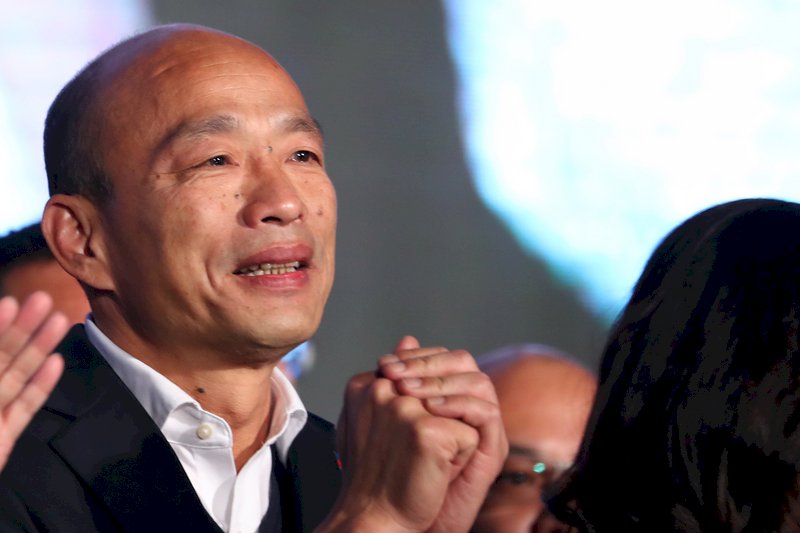
Kaohsiung mayor Han Kuo-yu is set to face his biggest political test on Saturday since he was defeated by President Tsai Ing-wen in the presidential race in January. A recall vote to remove him from office, the first of its kind in Taiwan’s history, will be held in the southern port city on June 6.
So who is Han Kuo-yu? Han was born in a military dependent’s village in what is now New Taipei City, in 1957. His father came from the central Chinese province of Henan. Han has a bachelor’s degree in English literature and a Master’s degree in East Asian Studies. His MA dissertation on cross-strait aviation talks from the perspective of China’s political warfare was published in 1988.
During his mayoral election campaign, Han referred to himself as an “old, ugly and bald vegetable vendor.” That’s because he had served as manager of the Taipei Agricultural Products Marketing Corporation for about four years. He projected the image of an average Joe who is practical, friendly and uses simple language that appeals to voters.
A member of the opposition Kuomintang (KMT), Han was elected Kaohsiung mayor in November, 2018 with 54% of the vote. It was a decisive win over the Democratic Progressive Party’s (DPP) Chen Chi-mai, the current vice premier, who got just 45% of the vote. The resounding victory not only turned Han into a political star, it also dealt a heavy blow to the DPP, which had governed the city of Kaohsiung for 20 years.
Now, Han is facing a recall vote. His opponents say he broke his promise to the residents of Kaohsiung when he decided to run for president just four months after taking office. Ten months into his term, he took a three-month leave of absence to run for president. Opponents say the recall move will help build a system that holds politicians accountable.
Other criticisms include Han’s low approval rating, which opponents say is the lowest of any city or county chief in Taiwan. They also say that he has “subjected the city’s development to irrevocable damage,” due to inaction. As for his sudden political popularity, they attribute that to interference from China-friendly media outlets, an issue that they say must be resolved. Finally, they have accused Han of sexual discrimination and of making discriminatory remarks against people from less developed countries.
Han’s opponents, led by a group called “Wecare Kaohsiung”, launched the recall campaign last summer. Some have close ties to the DPP, while others are from the Taiwan Statebuilding Party. In early March, the group collected over 400,000 signatures for a petition, and the Central Election Commission approved it a month later.
In order to remove the mayor from office, opponents need support from one quarter of eligible voters, or nearly 575,000 votes. Another threshold is that the votes in favor of a recall must outnumber the votes against it. As a result, “Wecare Kaohsiung” has been working hard to get as many people to vote on June 6 as possible, especially young voters, who are the DPP’s power base. The group says the recall vote is “asymmetric warfare.” They have accused Han of mobilizing the city government’s resources. They say he’s sought gangsters to help monitor the vote count in a move to block people from casting their vote, a claim that the Han camp has denied.
But “Wecare Kaohsiung” has also come under fire because of its ties with the government. Critics say the campaign literature, with the justice ministry’s logo, and an official hotline for reporting election fraud, violates the principle of impartiality. They say the government is biased toward “Wecare Kaohsiung”, and that the justice ministry shrugged off a complaint that the campaign had handed out promotional items that exceeded the legal price limit. The campaign has also raised eyebrows by calling the mayor names, like “virus spreader” and “pathogen.”
So what happens if the recall vote passes? According to the Civil Servants Election and Recall Act, if the mayor is recalled, he will be removed from office on the day the Central Election Commission announces the results. The announcement is expected within a week after the vote takes place. The Cabinet will appoint an acting mayor and a by-election will be held within three months. But if Han survives the political test, no recall vote can be held during the remainder of his four-year term.
Voter turnout is crucial to the recall vote, so Han and the opposition KMT are urging Kaohsiung residents not to vote. Instead, they say, residents should simply monitor the vote count. But on Wednesday, the DPP accused the KMT of employing what they called “undemocratic” tactics, during a milestone vote in Taiwan’s democratic history.