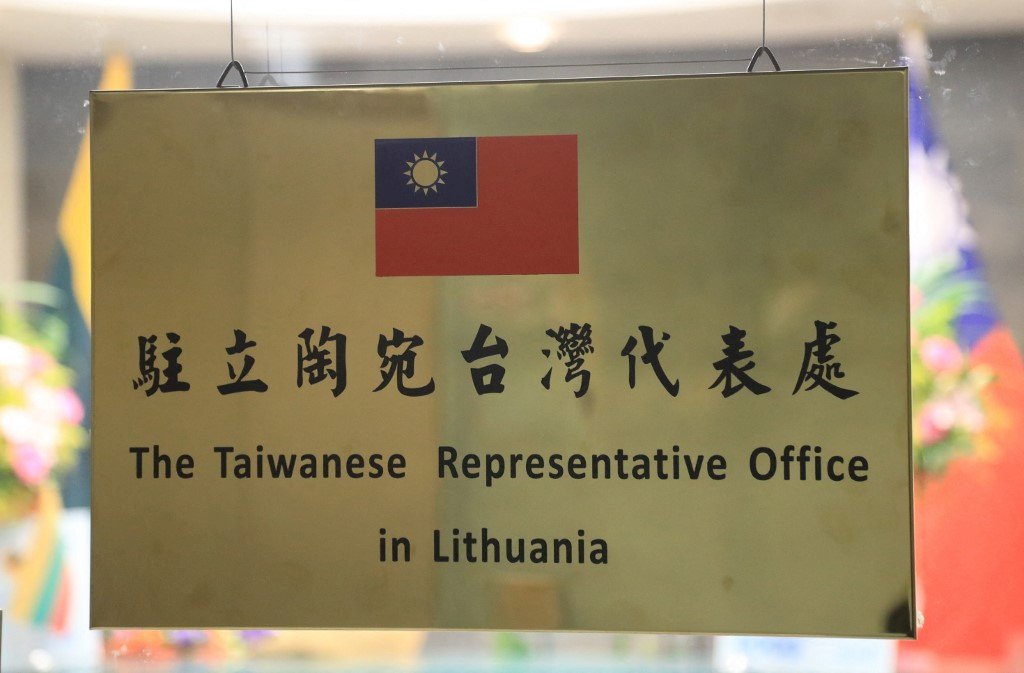
In last week’s edition of Newsmakers, I looked at a country that has been making headlines here in Taiwan for a few months now - the small Baltic state of Lithuania. Within the confines of a relatively short segment, I hoped to present a broad outline of some facets of Lithuanian history that might, to some extent, guide its foreign policy decisions today, especially with regard to Taiwan.
Modern-day Lithuania lies along the eastern coast of the Baltic Sea. It borders Poland and the Russian enclave of Kaliningrad to the south, Belarus to the East, and Latvia to the north. It was once the largest state in Europe, but today, it is a relatively small country, with an area of only 65 thousand square kilometers and a population of 2.8 million. Area-wise it is twice the size of Taiwan, but only around 12% of the population. Lithuania is a member of the European Union, the eurozone, the Schengen agreement, and NATO. It enjoys a high general standard of living, and ranks highly in the Human Development Index, as well as on civil liberties, press, and internet freedoms.
The medieval polity of Lithuania began forming in the 12th century and by the 13th century it took the shape of the Grand Duchy of Lithuania. It quickly found itself surrounded by powerful neighbors, most notably various Russian states to the East and Teutonic Knights to the southwest. The latter made it their mission to forcibly convert Lithuania, which was largely still following traditional beliefs, to Christianity.
The Duchy kept expanding southeast over the course of the 14th century, eventually reaching the Black Sea, and covering vast swaths of modern-day Belarus, Ukraine, parts of Poland and Russia.
In 1385, the Lithuanian Grand Duke Jogaila married the young Polish queen Jadwiga and became the king of Poland. This not only strengthened his domain, but was also aimed at halting assaults by Christian knightly orders, since Jogaila was required to convert to Catholicism before marriage.
Jogaila forged a personal union between Poland and Lithuania and started a dynasty that would rule both states for centuries to come. In 1569, the two countries voluntarily agreed to form the Polish-Lithuanian Commonwealth, a type of political entity with some similarities to a modern-day federal state. Both Poland and Lithuania retained some of their institutions, like separate armies, currencies, and laws.
The Polish-Lithuanian Commonwealth practiced a form of representative democracy, albeit reserved only for the nobility. The vast majority of its rural population were serfs, a step above slaves, bound to the land on which they lived and often bought and sold together with it.
The nobility, on the other hand, was busy maintaining and expanding their privileges, which eventually led to the weakening and stagnation of the Commonwealth. On May 3 1791 the Great Sejm, or parliament, of the Commonwealth adopted the world’s second codified national constitution, after the United States Constitution of 1787. The document sought to create a more democratic system of constitutional monarchy and rein in the worst excesses of powerful nobles. Unfortunately, it proved to be too little too late, and in the following few years the Commonwealth was invaded and partitioned by its three powerful neighbors - Russia, Prussia, and the Habsburg Empire.
Over the course of the 19th century, Lithuanians fought for independence in a series of unsuccessful armed uprisings. The majority of Lithuanian lands fell to Russia and were subjected to intensive russification. This made Lithuanian press illegal, forced cultural and educational institutions to close, and integrated Lithuania into Russian state structures. This effort largely failed - many Lithuanians dedicated themselves to smuggling in books, and teaching children Lithuanian in secret.
On February 16, 1918, towards the end of World War I, Lithuania declared independence as a democratic state, with Vilnius as its capital. The young state had to fight three wars to keep its newfound freedom - against the Bolsheviks, against the remnants of the Russian imperial army, and against Poland, which also regained independence the same year. After a staged mutiny, Poland was able to annex the capital region of Vilnius, and the relationship between the two countries remained hostile until World War II.
In 1926, a military coup installed a conservative authoritarian government, which ruled the country until the war. During World War II, Lithuania was first annexed by the Soviet Union, then taken over by Nazi Germany, and finally re-occupied by the Soviets in 1944. The Soviet Union established the puppet state of Lithuanian Soviet Socialist Republic and incorporated it into the USSR.
Mass deportations to Siberia and other atrocities committed by Soviet rulers led to armed guerilla resistance in Lithuania, which lasted until 1953. The USSR’s harsh treatment of partisan fighters is today classified as genocide by both Lithuanian courts and the European Court of Human Rights.
On March 11, 1990, Lithuania became the first Soviet republic to restore its independence. Even a harsh economic blockade, which resulted in shortages of fuel, essential goods, and even hot water, was not enough to break the Lithuanian independence aspirations. In the following years, Lithuania adopted a constitution, expelled the remnants of the Soviet army, joined the World Trade Organization, NATO, and eventually the European Union.
In recent months, a wave of Lithuanophilia, or the love of Lithuania, has swept Taiwan. The reason? During the height of Taiwan’s Covid vaccine shortage, Lithuania first donated a batch of 20,000, and later over 200,000 doses. Soon after, the two countries decided to open representative offices in each other’s capitals. This might not have been that unusual, if it were not for the fact that the Taiwanese office in Vilnius will bear the name “Taiwan”, while names of similar institutions in other European countries typically only include the name “Taipei”. This is ultimately a small, symbolic gesture, but it proved to matter in Taiwan.
On the other hand, this move has caused typical indignation in Beijing. The Chinese government quickly decided to downgrade its own diplomatic relationship with Lithuania to the level of charge d’affaires, and crossed the country out from its customs registry. Undeterred, Lithuania plans to open its representative office in Taiwan in early 2022.
Last week, a delegation of predominantly Lithuanian lawmakers, that also includes parliamentarians from two other Baltic states of Latvia and Estonia, arrived in Taiwan. They took part in a conference on democracy in Taipei later that week. In interviews for the press, Lithuanian lawmakers and diplomats often say that Lithuania hopes to become a model for the rest of Europe on how to maintain good relations with Taiwan and how to approach China. They also stress Lithuanian devotion to freedom and democracy. Lithuania, they say and as we’ve heard today, has a history of being ruled by harsh, authoritarian regimes, but also of resisting them.
This is by no means the predominant approach in Europe. To illustrate the difference, let us quickly look at Poland, another country that proclaims its devotion to freedom and antiauthoritarianism. Following the Lithuanian donation of vaccines, Poland announced it would also send 400,000 doses to Taiwan. However, a day after the announcement, Polish Foreign Minister Zbigniew Rau, who was, incidentally, visiting the Lithuanian capital of Vilnius at the time, said during a press conference that the Polish position on the matter of Taiwan was clear. He said Poland considered Taiwan to be a part of China. A tweet announcing the donation of vaccines to Taiwan, that had been published through the Polish foreign ministry’s official Twitter account, was promptly deleted. A tale of two countries, and a tale of two approaches, it would seem.