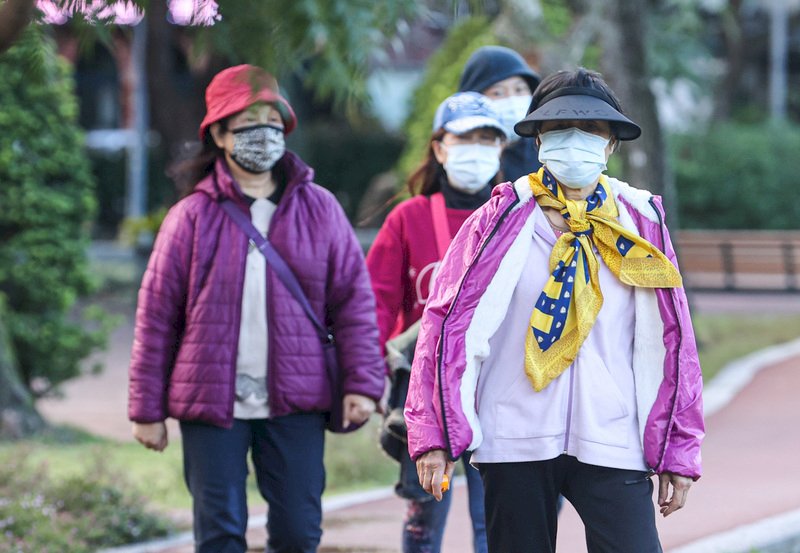
In the early hours of Wednesday morning, a weather station in Taipei recorded the city’s lowest temperature of the winter so far: 12 degrees Celsius. In comparison, southern cities such as Tainan have seen temperatures of around 23 degrees this week. The south of Taiwan is tropical, and so experiences gorgeous warm weather and sunny skies all year round. northern Taiwan however is very much feeling the winter cold, with thick winter coats, jumpers, hats and gloves now the fashion in Taipei.
Taiwanese people often like to complain about the weather in northern cities such as Taipei and long for the mild days of spring and early summer to return. However Taiwan’s winter season is actually at risk of being wiped out due to climate change and rising temperatures.
As the climate changes rise in Taiwan, all four seasons are seeing changes in their average temperature. Some Taiwanese scientists believe that Taiwan could lose any sign of a winter season at all by 2060 as a result of climate change. Over the past 110 years, the global average temperature has increased by 1.07 degrees. However, Taiwan’s annual average temperature has increased by a higher 1.6 degrees. This has already seen a shortening in the annual average winter season, which currently stands at around 70 days per year. In the next few decades, this number is predicted to keep decreasing, potentially even reaching a point where the entirety of Taiwan has no winter season altogether.
Having shorter winters doesn’t seem too awful in principle. However these kinds of changes disturb ecosystems and the natural order in Taiwan. In addition, the flip side of this is that climate change is also affecting Taiwan’s summers and will most likely continue to. Currently, a really hot day in Taiwan where the temperature goes above 36 degrees in most of the country only happens about once a year. However Climate Change researchers predict that this could become 48 days per year by the end of the century unless effective measures are taken. If global temperature increases can be limited to 1.5 degrees, then this number would only increase to 6 days per year, however that still represents quite a significant change.
Longer, warmer summers would have devastating impacts. Taiwan would experience more droughts, more power shortages and more perhaps even unbearably hot conditions. Since the 1960’s Taiwan has seen a large decrease in the number of rainy days per year and the intensity of the rains. This has affected everyone in Taiwan, from farmers who don’t have enough water to irrigate their farmland to the semiconductor industry that requires water to clean the waters that go into tech devices.
What is it that’s affecting this change, and why has Taiwan’s temperature change been comparatively severe? Greenhouse gases like Carbon Dioxide trap heat within the earth and cause global temperatures to rise. Taiwan’s contribution to greenhouse gas production is far from insignificant. Taiwan’s per capita carbon dioxide emissions are more than twice the average global emissions and are even higher than China’s. In total, Taiwan’s carbon dioxide emissions are the equivalent of Spain’s and make up around 0.75% of the planet’s total emissions despite Taiwan’s population only making up around 0.3% of the world’s population. This carbon dioxide comes from things such as Taichung coal power plant. In 2018 it was estimated to be one of the ten most carbon polluting coal plants in the world.
A survey from April 2020 found that 85% of Taiwanese people believe that they’ve already been impacted by climate change to some degree, and this is likely to be 100% within the not too distant future. If you’re in Taiwan right now, affected by the cold front and the winter weather, just know that soon Taiwan’s winter could be a thing of the past. By that point, we’ll all be looking back on them wistfully, wondering where we went wrong.