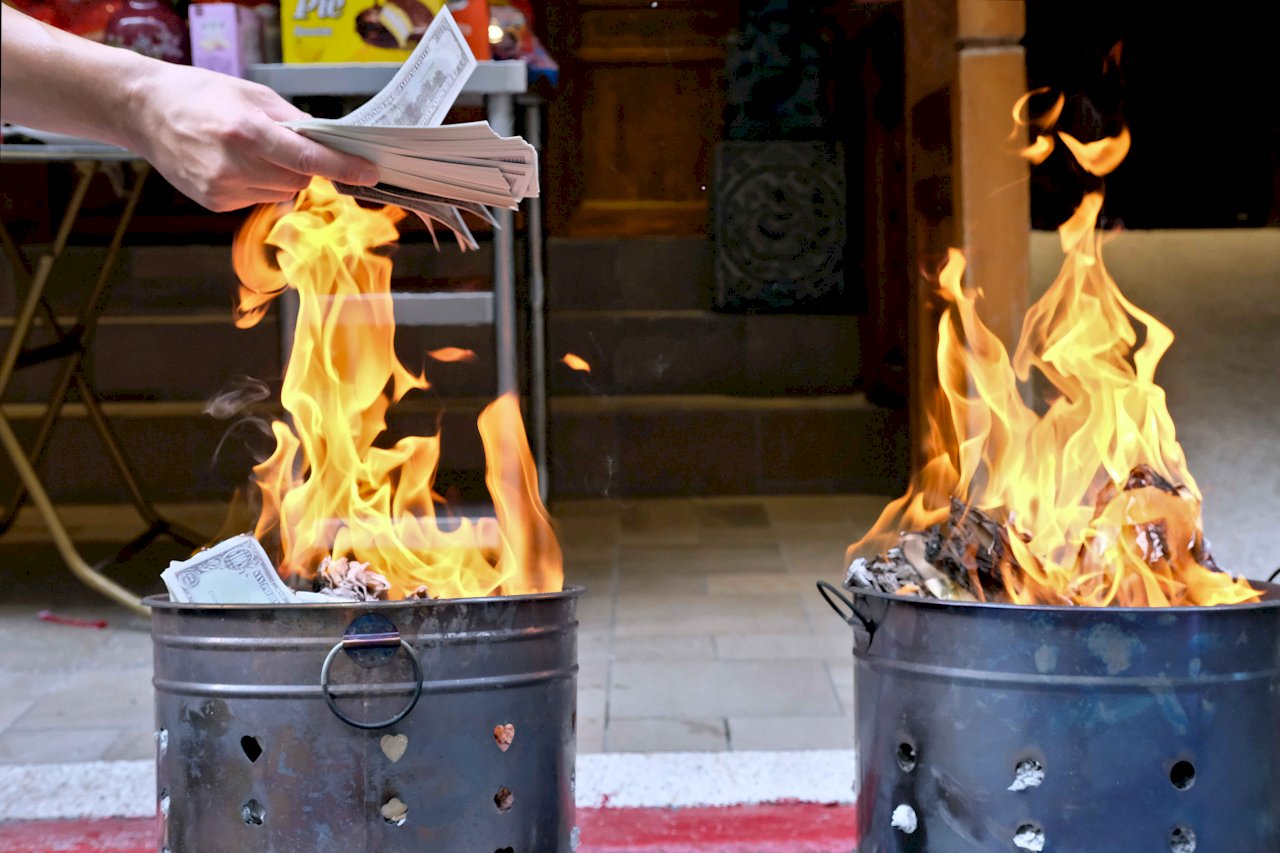
In a witty article on Taoist and Chinese popular religion in Taiwan, scholar John McCreery poses an unassuming question about why offerings of food are real while offerings of money are not.
His research is light-hearted, yet serious. Why not offer real money and spirit food instead? Or conversely, why can't paper food become real food for spirits?
McCreery posits that the answer lies in the role of food and money in Chinese society.
Food, he says, is presented at the beginning of the ritual as an invitation, summoning spirits forth to feast and establishing a relationship between the giver and the receiver. Metaphorically, it symbolizes a connection and must be real for the bond to be real.
Money, in contrast, is burned after the meal, bidding spirits farewell and returning them to the underworld. Metaphorically, it signifies a separation and must be fake in order to function as a parting gift.
But perhaps there are other real world reasons for why to substitute mock money for genuine cash. As it turns out, burning legal tender is a violation of the law in Taiwan.