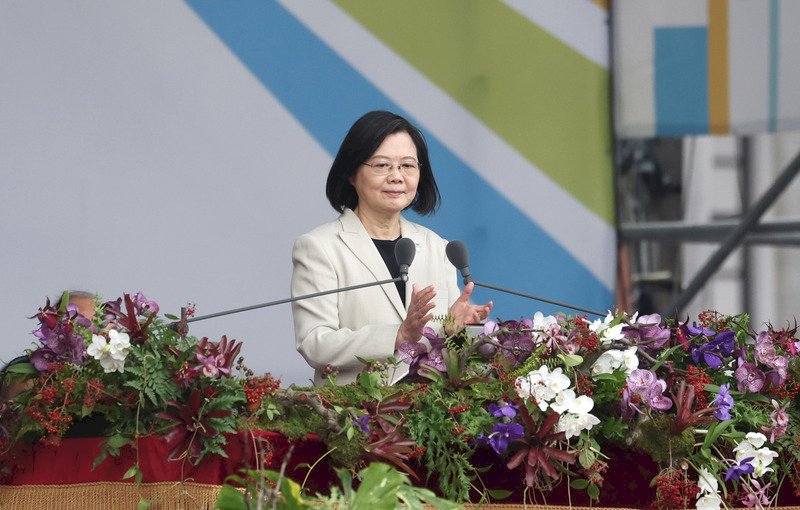
Taiwan celebrates its National Day each year on October 10, the anniversary of the 1911 Wuchang Uprising, which led to the collapse of China’s last imperial dynasty and the establishment of the Republic of China. This year’s events were celebrated with the usual pomp and circumstance, with important speeches and ceremonies across the country, despite less-than-perfect weather.
National Day in Taiwan is celebrated each year on October 10, which gives the holiday its common name — Double Ten.
The programme of the main celebration in front of the Presidential Palace in Taipei usually includes speeches by the President, the Legislature President and an overseas representative. There’s also a military parade with aerial elements, and various art performances, but smaller ceremonies are held throughout the nation.
Perhaps the most awaited part of the annual celebrations is the president’s speech. It usually outlines the achievements and challenges the administration regards to be the most important.
President Tsai opened her remarks by talking about the challenges of the COVID-19 pandemic. She said Taiwan managed to see 6.57 percent economic growth in 2021 and show its resilience despite global economic challenges.
Tsai also said that the rapidly changing post-pandemic world poses significant challenges, both economic and geopolitical. To strengthen Taiwan’s ability to weather the difficulties, Tsai promised to enhance the country’s resilience in four areas: economy and industry, social safety net, free and democratic government system, and national defense. These “four resiliences” would add to the four commitments Tsai made during her speech at last year’s National Day celebration. Those were commitments to free and democratic constitutional system, to the fact that the Republic of China and the People's Republic of China should not be subordinate to each other, to resisting annexation or encroachment upon Taiwan’s sovereignty, and to the future of Taiwan being decided in accordance with the will of its people.
Tsai said Taiwan will continue to take responsibility for its own self-defense, echoing earlier statements by Taiwan’s Defense Minister Chiu Kuo-cheng. The president said Taiwan is ramping up mass production of precision missiles and high-performance naval vessels, as well as developing comprehensive asymmetric warfare capabilities.
The president also highlighted Taiwan’s key role in the semiconductor industry. She said that contrary to what many around the world may believe, the concentration of semiconductor production in Taiwan is not a risk, but rather the key to reorganizing the global semiconductor industry. Tsai said the government will try to maintain Taiwan’s advantages in the sector and help optimize supply chains to give Taiwanese manufacturers an even more prominent global role.
President Tsai also talked about numerous domestic issues. Those included healthcare and, more specifically, Taiwan’s ability to provide medical services during emergencies like earthquakes. She also said the government has done a lot in the recent past to improve Taiwan’s critically low birth rates and enhance social benefits for the groups that need them most.
In the final part of her speech, President Tsai attempted to ease cross strait tensions which have been very high due to escalated Chinese military activity near Taiwan. She said Taiwan is willing to work with China for a mutually agreeable arrangement for peace and stability in the Taiwan Strait. She said she is looking forward to resuming people-to-people exchanges with China when Taiwan’s national borders open to tourist travel on October 13. Tsai urged Beijing to respect Taipei’s sovereignty and said that military confrontation is “absolutely not an option.”
With Taiwan in a precarious geopolitical position, at the core of multiple countries’ security concerns, many listened closely to President Tsai Ing-wen’s National Day remarks. It is, after all, up to her administration to navigate present challenges and ensure stability and development both internationally and at home.
Tomasz Koper, RTI News