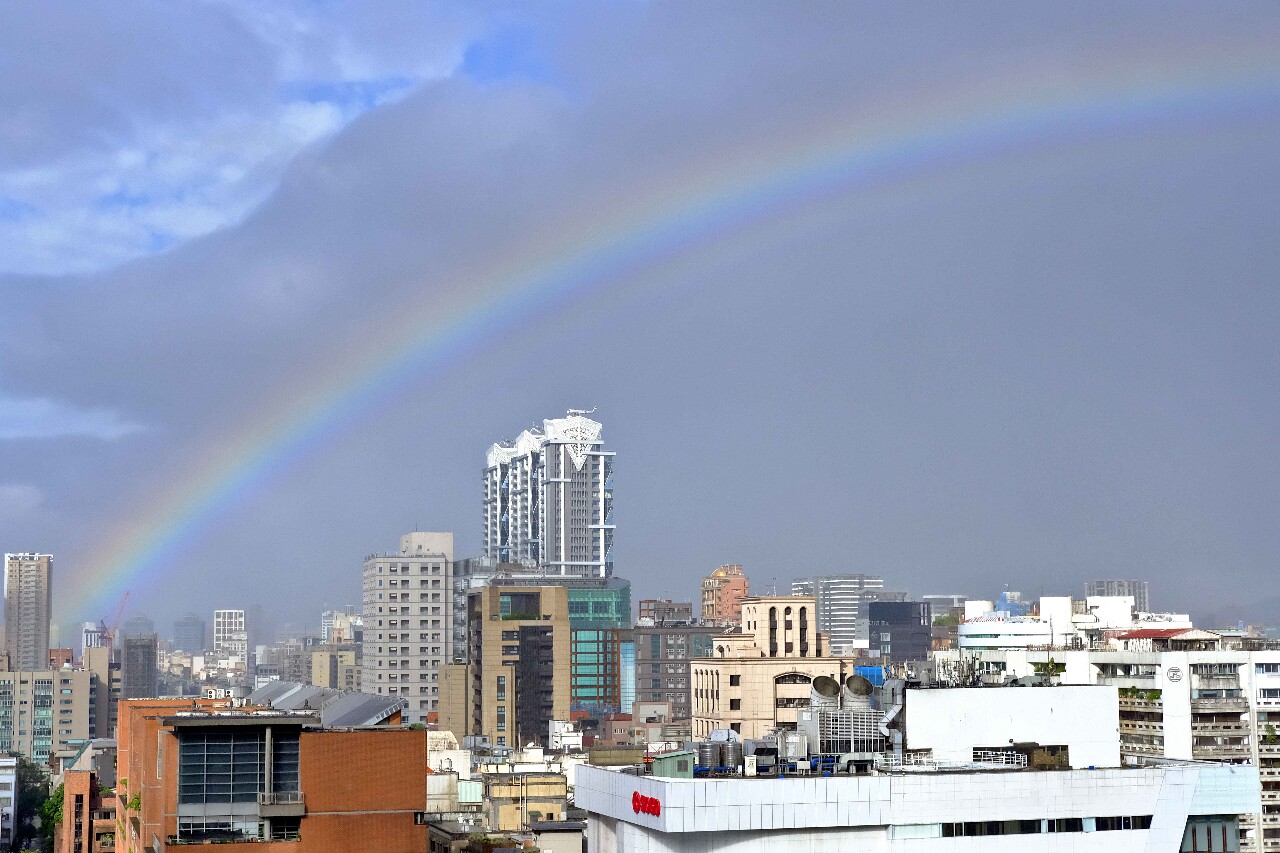
A vivid rainbow appeared in Taipei early Monday morning. The colorful arc of light spanned the blue-gray skies from Shulin in the far southwest to Neihu in the far northeast. The optical phenomenon was a welcome respite from the long periods of rain that have drenched Taiwan this year.
This year’s precipitation has been a striking change from last year, when the most severe drought since the 1960's ravaged Taiwan. In 2021, the absence of rain impacted food security, threatened the semiconductor industry, resulted in water rationing, and caused other problems.
Such characteristic risks of climate change on life in Taiwan can be expected to occur with increased frequency and magnitude in the coming decades, presuming that temperatures continue to rise.
But a new study published by a team of researchers in the United States suggests that the effects of future global warming may not be uniformly negative. The authors predict that more rainbows could also potentially emerge.
An additional benefit they found is that islands may be the best place to view rainbows because of their topography. Such a positive outcome amid the tremendous disruption of climate change is expressed well in the English saying, “every cloud has a silver lining”.