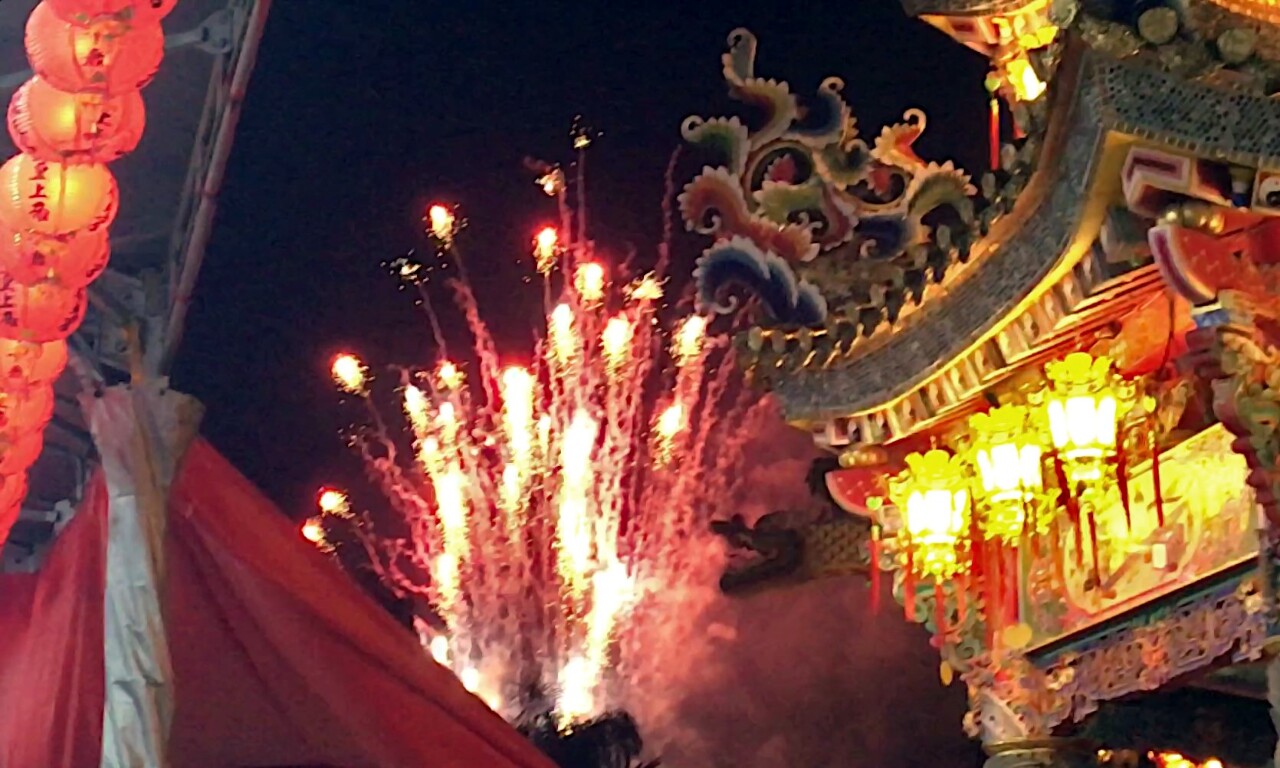
In Taiwan, in contrast to the solar year, which begins at midnight, the turn of the lunar new year is celebrated at 11 pm. This is because traditionally the lunar year is marked by twelve “earthly branches” that are divided approximately into two-hour periods in a day.
These are: 11 pm – 1 am (zi), 1 am – 3 am (chou), 3 am – 5 am (yin), 5 am – 7 am (mao), 7 am – 9 am (chen), 9 am – 11 am (si), 11 am – 1 pm (wu), 1 pm – 3 pm (wei), 3 pm – 5 pm (shen), 5 pm – 7 pm (you), 7 pm – 9 pm (xu), and 9 pm – 11 pm (hai).
Each of these units not only identifies the time, but also stands for an interchanging movement of elemental forces that have cosmological significance. Thus, zi, the first of the twelve earthly branches, which corresponds with midnight, is also considered to represent a crucial transitional phase in time.
Symbolized by the character for “seed” or “infant”, zi or midnight coincides with a period of regeneration and inception. As the old lunar year ends then at 11 pm, the new lunar year will offer hope and the possibility of a new beginning.