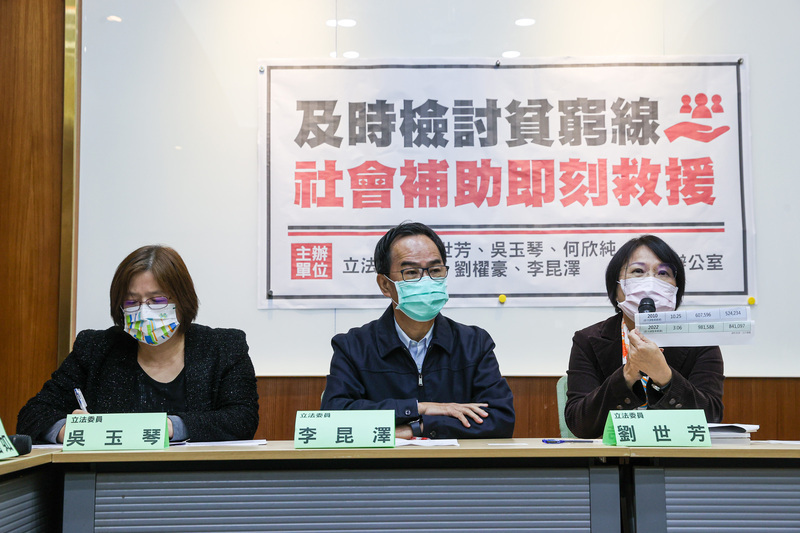
A bipartisan group of lawmakers are seeking to expand social assistance when the legislature comes back into session next month. 18 amendments to Taiwan’s welfare law have been proposed since February 2020.
Taiwan’s poverty line is equal to 60% of the median disposable income per household member. That comes out to about NT$16,000 (US$500) per month.
According to this figure, less than 3% of households fulfill these requirements to receive assistance. DPP lawmakers Ho Hsin-chun (何欣純) says due to inflation and increases in the cost of living, this standard is leaving many at-risk families from receiving benefits.
Ho has proposed an amendment to the welfare law. Her proposal includes adjusting thresholds for income support, rental assistance, public housing eligibility, and student loans to expand the social safety net.
Ho also says certain measures in the welfare law must be adjusted to prevent low-income individuals from falling through the cracks. That includes limits on property owned by family members. Ho says this prevents single parent households or families with no connection to more affluent relatives from receiving benefits.
Meanwhile, KMT lawmakers Lin Te-fu (林德福) agrees that Taiwan’s poverty problem has not received enough attention. He supports Ho’s proposal to adjust thresholds to expand the social safety net.