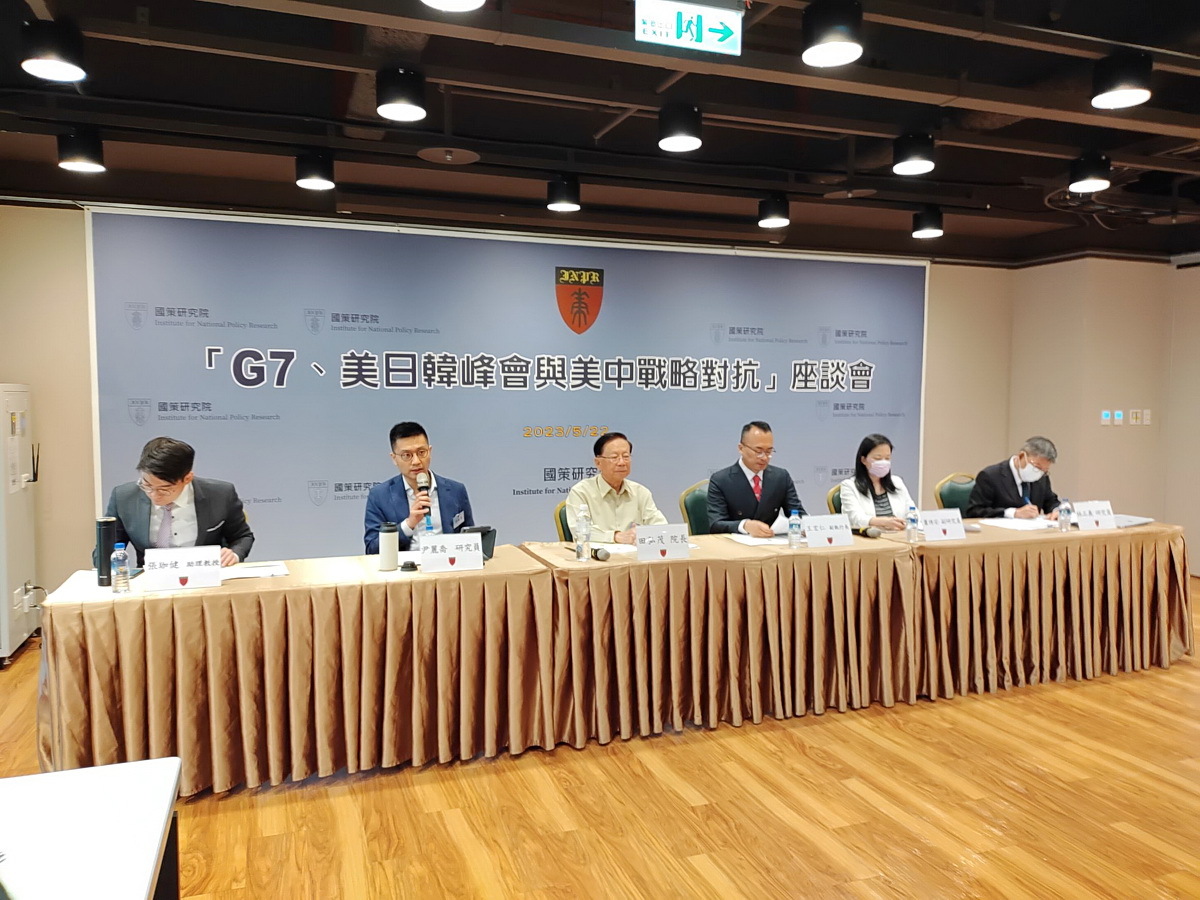
The recent statement by the Group of Seven (G7) countries shows that China’s diplomatic offensives in other countries have had limited impact. That’s according to researchers speaking at a post-G7 symposium held by the Taipei-based think tank Institute for National Policy Research (INPR) on Monday.
The joint communique released by the G7 countries emphasized ongoing tensions between themselves and the actions of Russia and China. While the G7 showed unity in opposing Russian and Chinese aggression, researchers at INPR pointed out that some of the statement’s language represented a compromise of sorts. In particular, they point to the G7’s claim that they are not “decoupling,” but rather “de-risking” their economic relations with Russia and China. The G7 statement called for reducing reliance on the two countries by diversifying supply chains for essential technologies and natural resources.
The statement also reaffirmed the “importance of peace and stability in the Taiwan Strait,” while also emphasizing that “there is no change in the basic positions of the G7 members on Taiwan,” including on the one China policy.
Taiwan National University researcher George Yin (尹麗喬) says the G7 meeting and statement show that despite China’s diplomatic offensive to split democratic countries, it has not succeeded. He says the central international conflict between democratic countries and dictatorships remains.
Associate research fellow at National Chengchi University's Institute of International Relations Hsiu-an Hsiao (蕭琇安) says the world is paying more attention to Taiwan. She says that recent statements from the NATO secretary general that “what happens in Asia matters to NATO,” is a good example. She says the time when NATO only thinks about Europe and neglects the Asia-Pacific may be undergoing major changes.