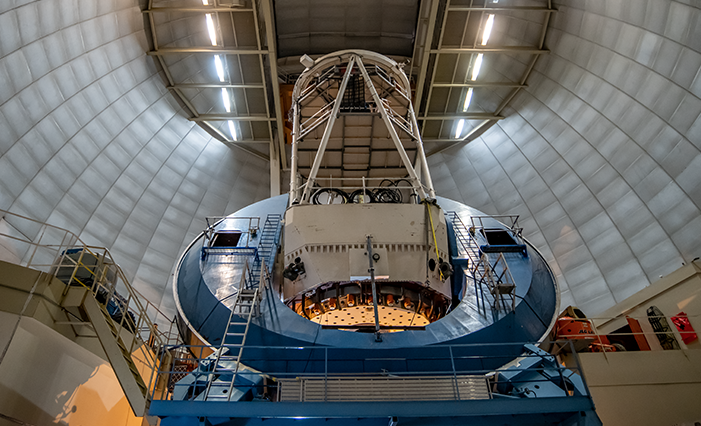
National Taiwan University and National Tsinghua University are now analyzing the massive amount of data obtained from the Dark Energy Spectroscopic Instrument (DESI), an instrument that measures the effect of dark energy on the expansion of the universe. Professor Lan Ting-wen (藍鼎文) of the NTU revealed that their team is developing new ways of processing the data with new technologies and AI.
DESI is a scientific research instrument operated by the Lawrence Berkeley National Laboratory to conduct spectrographic surveys of distant galaxies. The instrument enables astronomers to probe the expansion history of the universe and the mysterious physics of dark energy. DESI sits at 2,100 m (6,880 feet) on top of Kitt Peak in the Sonoran Desert near Tucson, Arizona in the United States.
By 2025, the DESI project will not only probe dark energy but also survey more than 40 million objects, including stars, distant galaxies, and supermassive black holes born in the early universe. It is expected to create the largest three-dimensional map of the universe in history, allowing astronomers to better explore the nature of dark energy.
Professor Lan is delighted that a Taiwan research institution could participate in an international project like DESI. He says that it shows there are many possibilities for Taiwan and its talented professionals. Lan also thanked the Ministry of Education, the National Science Council, and the two universities for supporting students and researchers’ participation, and nurturing Taiwan’s next generation of astronomers.