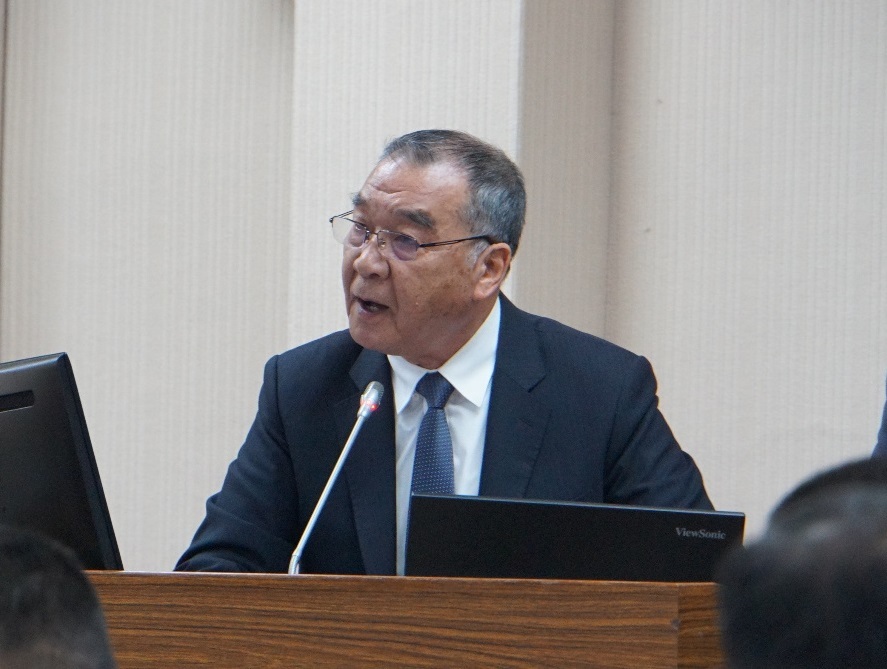
As China’s military expenditure rises, the Defense Ministry focuses on enhancing joint intelligence surveillance as well as urging the need for more detailed and comprehensive training exercises.
Video script:
The Chinese People's Liberation Army (PLA) displayed various missiles in a series of reviews. Taiwan’s Defense Ministry highlighted the PLA's shift towards "overseas operations" in recent years. The PLA Rocket Force accelerates the deployment of missiles such as the Dongfeng-17 and Dongfeng-100. The PLA Air Force is also adding more J-16 and J-20 fighter jets, aiming to enhance China’s military deterrence and long-range aerial strike capabilities.
Defense Minister Chiu Kuo-cheng (邱國正) says Taiwan’s military will continue to strengthen joint intelligence and surveillance methods, in order to monitor the latest movements of the PLA to ensure swift reaction.
China's military spending has surged by 7.2% this year, reaching a staggering RMB 1.67 trillion (US$232 billion), marking over 20 consecutive years of increase. Meanwhile, several U.S. arms sales to Taiwan have been facing delays.
Minister Chiu assures smooth progress in current negotiations with the U.S. for military purchases, reiterating Taiwan's stance to avoid engaging in an arms race. He emphasized the necessity to strengthen Taiwan's military capabilities through training and other means.
This year's annual Han Kuang Exercise, focusing on computerized wargames, is set to be extended from the usual five days and four nights to eight days and seven nights for the first time in 40 years. The exercise aims to verify Taiwan's responses in the grey zone and various stages of defense operations.
Chiu also spoke about adapting to changing scenarios and suggested the need for more detailed and meticulous training sessions due to the evolving challenges.