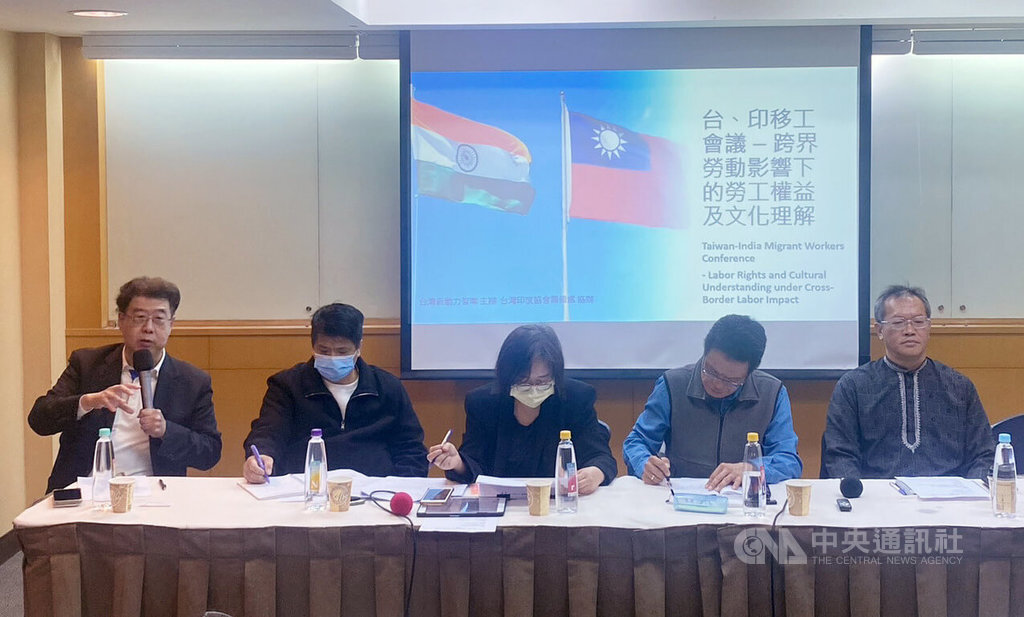
On Thursday, the think tank Taiwan New Power (台灣新動力智庫) along with the Preparatory Office of the Taiwan India Association held the “Taiwan-India Migrant Workers Conference,” inviting experts in academia, government, and civil society for diverse input on Taiwan-India labor cooperation MOU. The MOU was signed in February, with Taiwan planning to employ migrant workers from India.
Fang Tien-sze (方天賜), vice chair of the Center for India Studies at National Tsing Hua University, points out three reasons for negative responses regarding the MOU in Taiwan. The three reasons include locals not having sufficient knowledge of India, the lack of bilateral communication between the Taiwanese government and its civil society, and insufficient supporting measures of the MOU’s impact on Taiwan’s local labor force.
Recent remarks from Taiwan’s labor minister regarding migrant workers from India have received criticism. On March 5, Taiwan’s Labor Ministry issued an apology after Minister Hsu Ming-chun (許銘春) said Taiwan would first recruit Indian migrant workers from Northeast India, citing skin color and diet as reasons. In an interview with TaiwanPlus, Dr. Priya Purswaney, translator and consultant from India, now based in Taipei, shared that the Indian community in Taiwan was surprised and slightly shocked by the initial remarks from the labor minister. Dr. Priya Purswaney also pointed out the lack of sensitivity in Taiwan’s society regarding issues of race and culture.
Labor Ministry senior specialist Hu Hsin-yeh (胡欣野) says the ministry had a cross-departmental specialist consultant conference on March 1 with experts from both Taiwan and India present. This included Taiwan government officials of the Foreign Ministry, Interior Ministry, and Health and Welfare Ministry, as well as scholars and non-governmental representatives in Taiwan. Hu says there will be another upcoming specialist consultant conference to invite diverse input regarding the labor collaboration MOU.