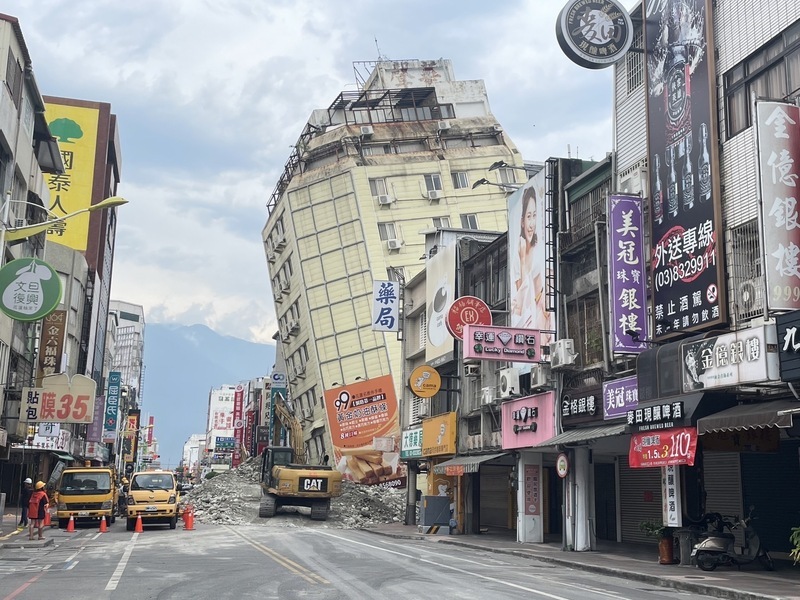
Following the 7.2 magnitude earthquake on April 3, there have been intense and frequent aftershocks causing further damage in Taiwan’s eastern city of Hualien.
Video script:
At Hualien’s Dong Hwa University, the damage from the April 3 earthquake has yet to be fully repaired, and persistent aftershocks continue to cause even more damage on campus. Between Monday and Tuesday morning alone there were 180 aftershocks. The Central Weather Administration’s (CWA) Seismology Center Director Wu Chien-fu (吳健富) says the recent tremors are likely aftershocks of the 7.2 magnitude earthquake on April 3.
Initially, most aftershocks were concentrated in the waters east of Hualien. However, over time the epicenters have shifted from the sea towards land, gradually moving southward, and the depth of the tremors has become shallower.
The CWA says the aftershocks might be due to stress transfer, where the surrounding faults are affected by stress and rupture prematurely. However, predicting the magnitude and timing of the aftershocks remains challenging.
Experts estimate that aftershocks with a magnitude of around five will persist for about six months, while those with a magnitude of three to four could last up to a year. During this period, there is a risk that aftershocks could trigger other faults, leading to a new wave of earthquakes.
The recent earthquake on April 3 was the largest since the 921 earthquake 25 years ago. As aftershocks could continue for a considerable time, the public is reminded to remain vigilant during this time.