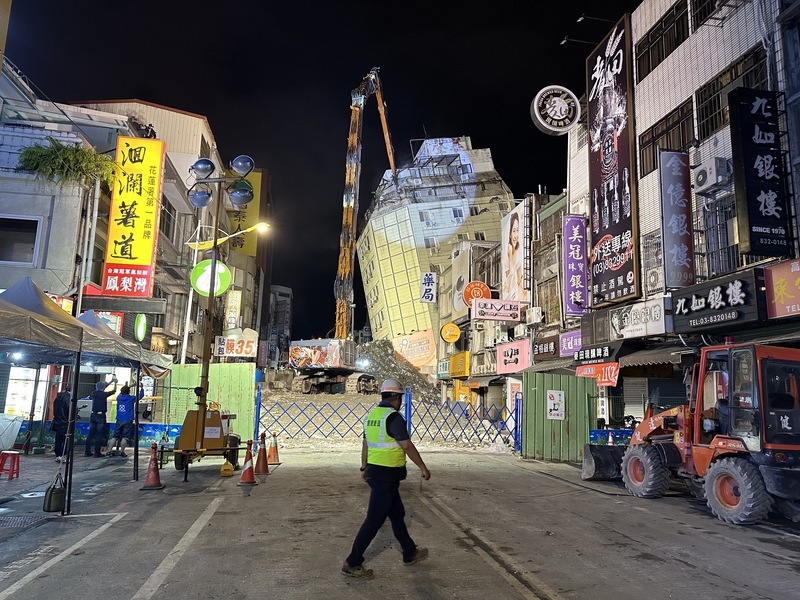
After the April 3rd strong earthquake, aftershocks continued throughout Taiwan, but yesterday’s 4 earthquakes are believed to be independent events.
Video script:
The scene of swaying of hanging lights has become a common sight, occurring almost daily since the strong tremors on April 3.
In the early hours of Thursday morning, a series of four earthquakes struck Taiwan, ranging between magnitudes 3.9 and 5.6 on the Richter scale. Two earthquakes of magnitudes 5.6 and 5.5 occurred one minute apart, both felt throughout Taiwan, with the highest intensity recorded at level 3. However, the Central Weather Administration (CWA) clarified that these four earthquakes were independent ones originating from the Nan'ao Basin, unrelated to the April 3 earthquake.
Professor Wu Yi-min (吳逸民) of the Department of Geosciences at National Taiwan University explained that when the epicenter is further away, the time between the P-wave and S-wave increases. P waves can travel through liquid, solid, and gases, while S-waves only travel through solids. This phenomenon extends the time of tremor people could feel. However, the Taipei Basin experiences amplification due to its basin effect, making the shaking feel more pronounced.
Conversely, the distance of the Nan'ao Basin results in larger discrepancies, prompting Yilan to receive a national-level warning. However, examining geological cross-sections, it's evident that the epicenters of the four earthquakes and the April 3 earthquake were different.
Professor Lee Chyi-tyi (李錫堤) of the Institute of Applied Geology at National Central University noted that after the April 3 quake, aftershocks were concentrated near the same fault zone, resulting in fewer earthquakes elsewhere. With the occurrence of the Nan'ao Basin earthquakes, aftershocks from the April 3 quake are expected to decrease significantly, offering hope for a reduction in aftershock frequency. Nonetheless, with over 1,200 earthquakes accumulated by Thursday morning since the main earthquake, there is still a possibility of aftershocks within the next six months to a year. The CWA urges the public to remain prepared and vigilant.