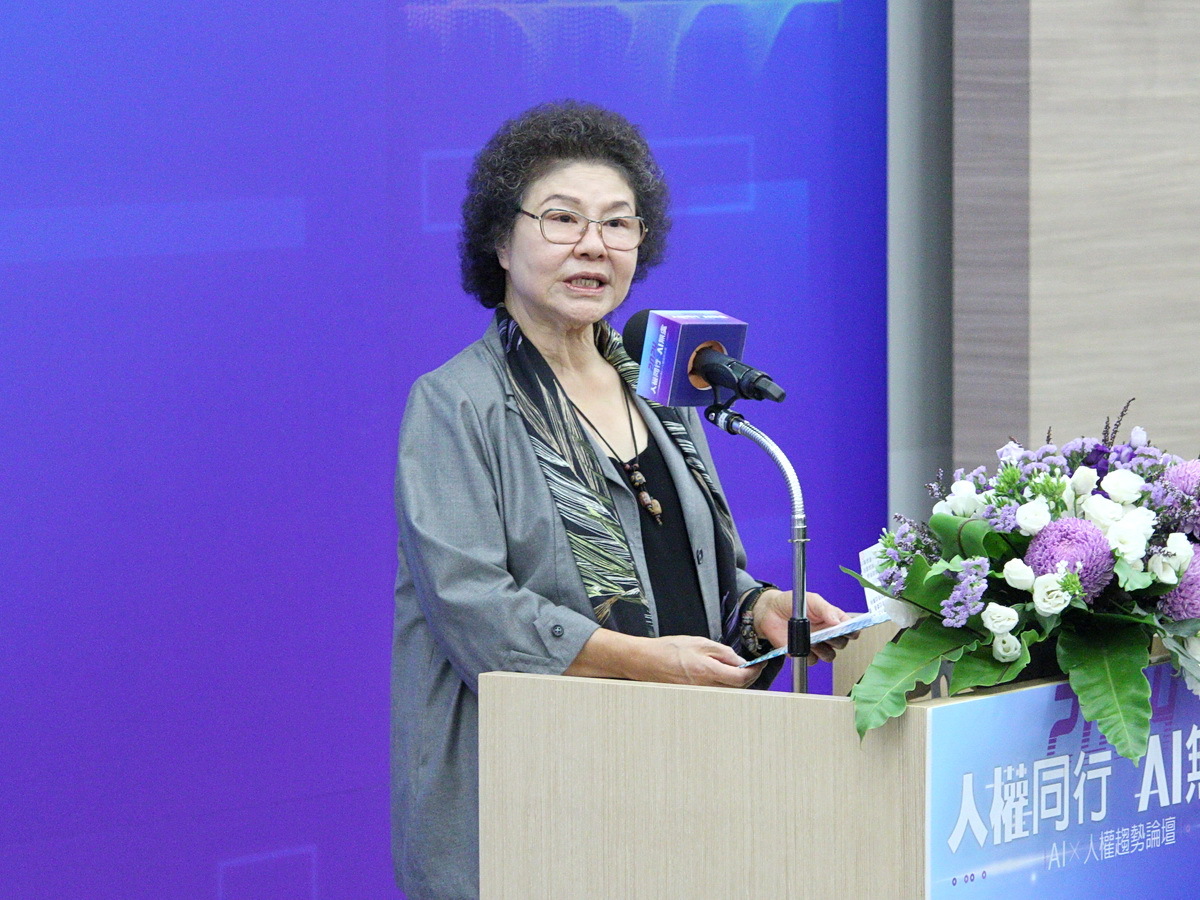
The National Human Rights Commission held a forum on AI this Friday, bringing together domestic and international experts. The forum aimed to provide policymakers, businesses, and society with guidance on safeguarding human rights during AI development and application.
As AI rapidly advances, concerns about its potential infringement on human rights have grown. National Human Rights Commission Chair Chen Chu (陳菊), says that as a member of the democratic and free world, Taiwan must bravely confront the human rights challenges posed by generative AI. She adds AI applications must fully respect and protect human rights.
Recently, the United Nations Office of the High Commissioner for Human Rights released a classification of human rights risks associated with generative AI. The document, based on the Universal Declaration of Human Rights, outlines potential threats to fundamental rights such as non-discrimination, privacy, freedom of expression, access to information, and the right to work. It calls on stakeholders to first identify the human rights risks involved in generative AI to take further action to prevent, mitigate, and remedy any harm.
Chen says the National Human Rights Commission is committed to aligning Taiwan's human rights practices with international standards. Further, that as generative AI may pose threats to privacy, spread misinformation, and even challenge core values of freedom of expression, she says Taiwan must face these challenges head-on.