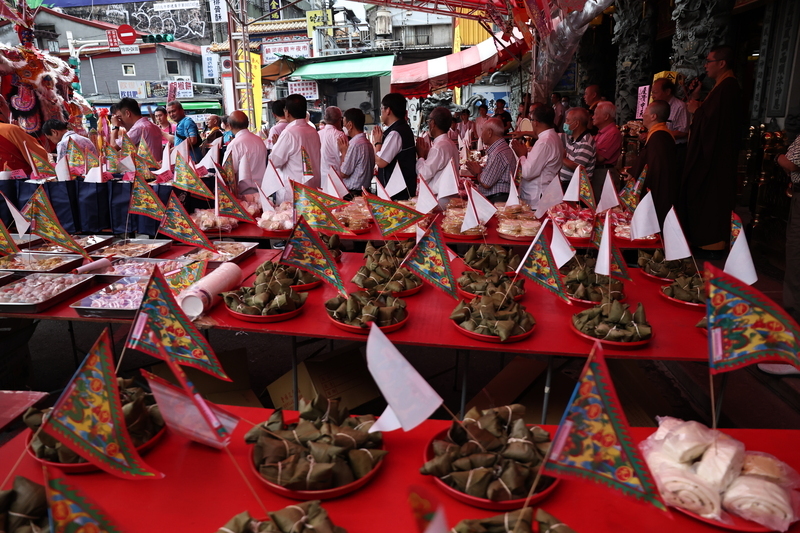
It is the Ghost Month in Taiwan, and all over the island many offering activities are held to honor and appease the spirits, each with their own unique set up and meaning.
The gong goes off, and the children rush to grab snacks, candies and cookies laid out on a big canvas. They carry all kinds of plastic bags, shopping bags, even garbage bags, trying to fill them up as much as possible.
After they finish the adults take over, competing with each other to catch small colorful balls with raffle tickets thrown from tall poles.
This is a scene in the offering ritual called “Sigu Qiangban” (四孤搶粄) at Daluguan in Pingtung County, which attracts thousands of participants. In 2015, it was classified by the county government as a part of their intangible cultural heritage.
Meanwhile, at Gangkou Temple at Dongshi, Chiayi County, another offering event was set up with 2,200 tables, 200 tons of white rice, and a display of 200 pigs. While the ritual has a 179-year history, this enormous spread set a new record for temple offerings this year.
Mr. Lin Zichu (凌子楚), in charge of the event, said they set up a high pole to expand the range of offerings to the spirits, hence the need for more tables and food.
These offering activities, or Pudu, are typically organized in the Ghost Month, in the seventh month of the lunar calendar. During this month, it is believed that the deceased will visit the living, and so they are offered gifts both out of respect and to not be tempted to bother those still living.
Samuel Feng for Rti News