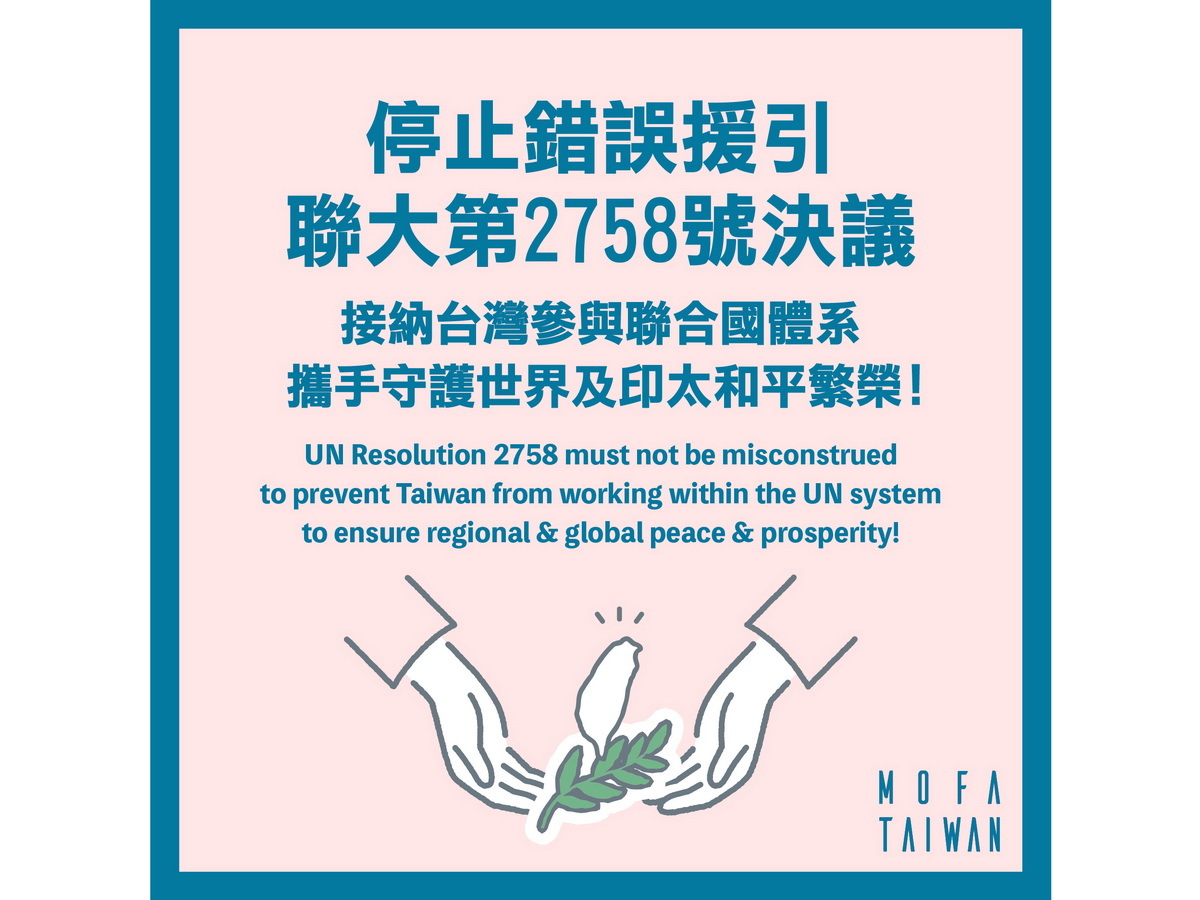
At this year’s United Nations General Assembly (UNGA), Taiwan’s Foreign Ministry intends to push a plan addressing the misuse of UN Resolution 2758, clarifying that China has a record of conflating the resolution with its One China principle and manipulating the international community to do the same.
The crux of the Foreign Ministry’s appeal links the resolution to the current status of cross-strait relations, and illustrates how China misuses the resolution to undermine Taiwan’s sovereignty and attempt to establish a legal basis for using force against Taiwan.
The Taiwanese side holds that UN Resolution 2758 does not mention and is irrelevant to Taiwan. Further, the resolution does not give China the right to claim that Taiwan is part of China, nor give it the right to represent Taiwan at the UN.
International Organizations Department Director General Jonathan C.Y. Sun (孫儉元) claims that international participation is a basic human right and common aspiration of the 23.5 million people in Taiwan; he called on the international community to prevent China from attempting to unilaterally change the status quo across the Taiwan Strait.
Speaking at a press conference for the first time since assuming his position as American Institute in Taiwan (AIT) Director, Raymond F. Greene expressed his opposition to the misuse of the resolution to obstruct Taiwan’s participation in the international community as well.
At an event held by Washington-based think tank the German Marshall Fund in late April, U.S. Deputy Assistant Secretary of State in the Bureau of East Asia and Pacific Affairs Mark Baxter Lambert clarified the four points underlying the United State’s position on UN Resolution 2758. This marks the fifth time a U.S. official has publicly stated their opposition to the resolution and clearly demonstrates their concern toward China’s intentions.