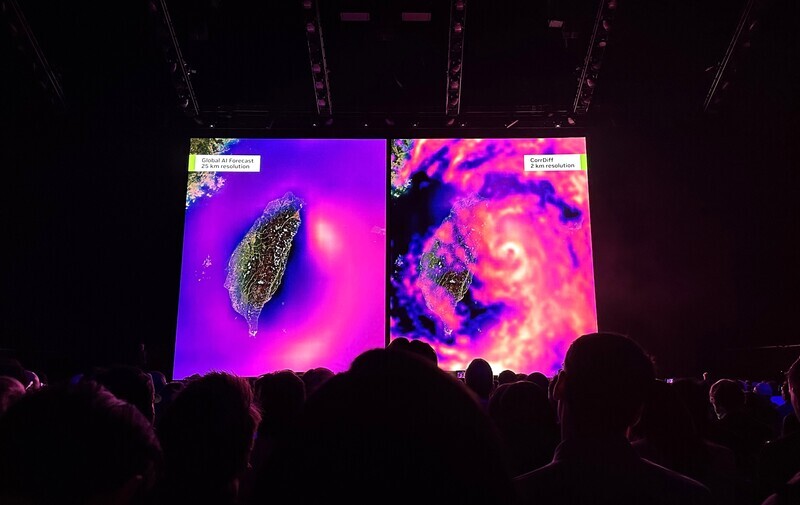
Taiwan averages 3.5 typhoons a year from June to October, which cause heavy rains and environmental damage. However, new AI technology will provide improved forecast accuracy that will enable Taiwan and other countries around the world to better prepare for inclement weather.
CEO of Nvidia Jensen Huang (黃仁勳) introduced Nvidia’s newly developed AI weather prediction technology in a recent event at National Taiwan University, saying that regional weather forecasts across hundreds, even thousands, of kilometers can soon provide clear pictures of the best, worst, and most likely impacts of storms such as typhoons.
Using Nvidia’s Generative Correction Diffusion Model (CorrDiff), Huang elaborates that the resolution of extreme climate events can be zoomed in from 25 kilometers to 2 kilometers, with 1,000 times the calculation speed and 3,000 times the energy efficiency of traditional weather models. AI-assisted software can now predict weather movement patterns in less than ten minutes compared to the previously required 3 to 6 hours. However it should be noted, the Central Weather Administration (CWA) states that AI tech cannot yet calculate storm intensity.
The CWA has already begun implementation of Nvidia chips in its supercomputers, employing their use on the incoming Typhoon Krathon. Hopefully, the AI engine’s better path prediction and impact times will be the only thing blowing away the Taiwanese public.