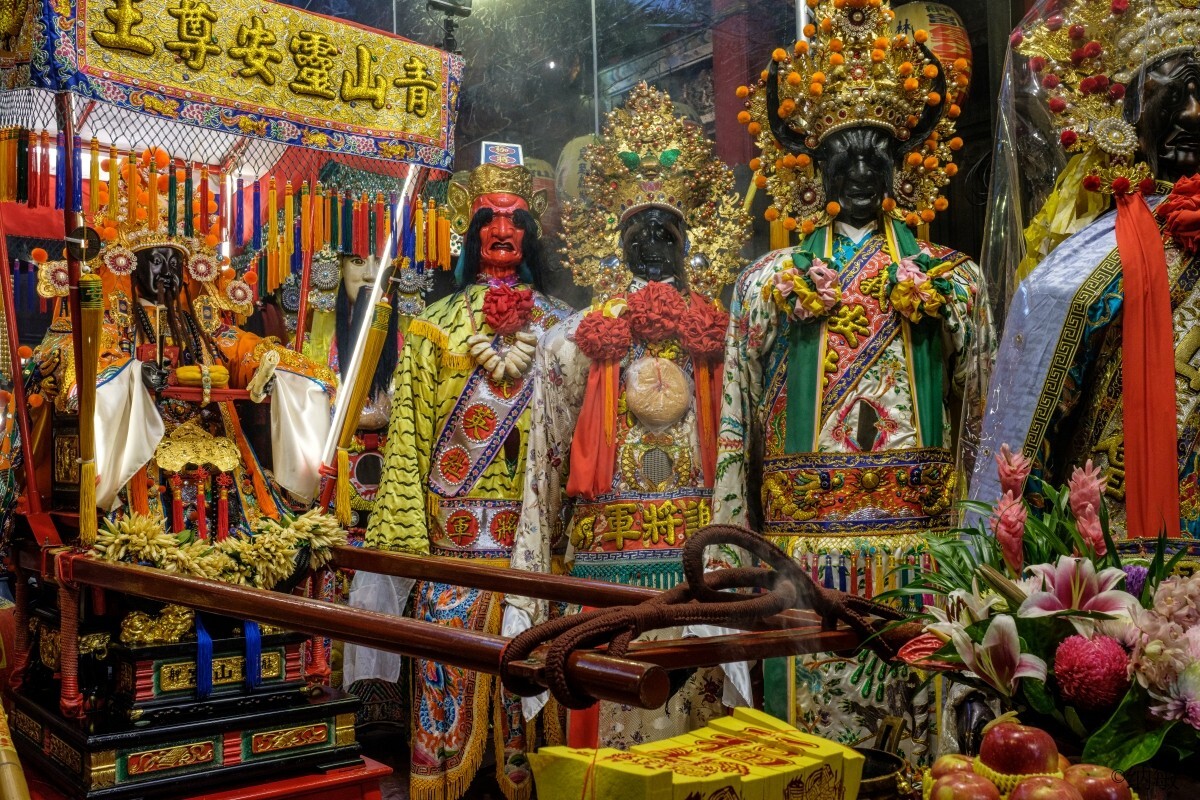
Thousands of well-wishers descended into the streets of Taipei’s Wanhua district on Friday evening in celebration of King Qingshan's birthday. Qingshan Ling’an Zunwang (青山靈安尊王), or the Venerable King of the Green Mountain, is a Taiwanese Taoist folk deity from Fujian, who is housed in the Monga (Mengjia) Qingshan Temple.
This year’s temple festival was fortunate to have dry weather and the god’s birthday fall on a Friday, mitigating people’s fears of having to go to school or work the next day. That led to an unusually large gathering of followers beginning at 9 am.
The pilgrimage lasted well past midnight with the deity and his entourage patrolling both the northern and southern sections of the district, visiting temples, calling on patrons and exchanging gifts with other local gods.
The atmosphere was at times boisterous and lively, at times ceremonial and solemn, and always respectful and inviting. The biggest threats appeared to be from unrelenting traffic and ear-splitting firecrackers that occasionally burst into flames, not that revelers seemed to mind.
Besides revelers, streets were also filled with traffic cops directing the flow of cars and motorcycles and an occasional ambulance and fire truck to maintain order in chaos. In a world of violence and terrorism, it was liberating to be amongst masses of people with so little visible security and yet feel so safe.
Festival-goers were the salt of the earth, of all ages and from all walks of life, full of personality and character. Their gifts of food, talisman and friendship, always with a warm smile and wish for ping'an (peace and tranquility), were touching in so many ways. Betel nut chewing was rife, but there was little noticeable intake of alcohol and no apparent intoxication.
Technology was also at a minimum and apart from antiquated sound systems that could perhaps have used an upgrade blaring suona horns, cymbals, drums and gongs, the pilgrimage’s music has surely not changed a beat. Barring traffic, it was easy to imagine a similar procession taking place in decades or even centuries past.
In English, the occasion is often called a party, but it felt more like a Taiwanese version of The Nutcracker for its theatrical troupes and Disney for its floats with some Christmas, Halloween and Thanksgiving. As one participant remarked, a party can take place every day, but this can only happen once a year. “It’s not joyous”, she added, using the Chinese term huanle (歡樂).
Surely, an undertaking of such magnitude would be bolstered by a sizable economy. Nevertheless, the festival looked entirely community-based and apart from the names of some local businesses gracing a god’s sedan-chair or vehicle indicating sponsorship, there was refreshingly little that seemed commercial about it.
There also seemed to be little concept of time in the industrial sense. After all, the celebration lasted three days and gods like people took ample breaks throughout to rest, eat, drink and socialize.
The Qingshan Temple festival is an important religious event, but there is an inherently human dimension to it that makes it particularly memorable and meaningful for believers and non-believers alike.