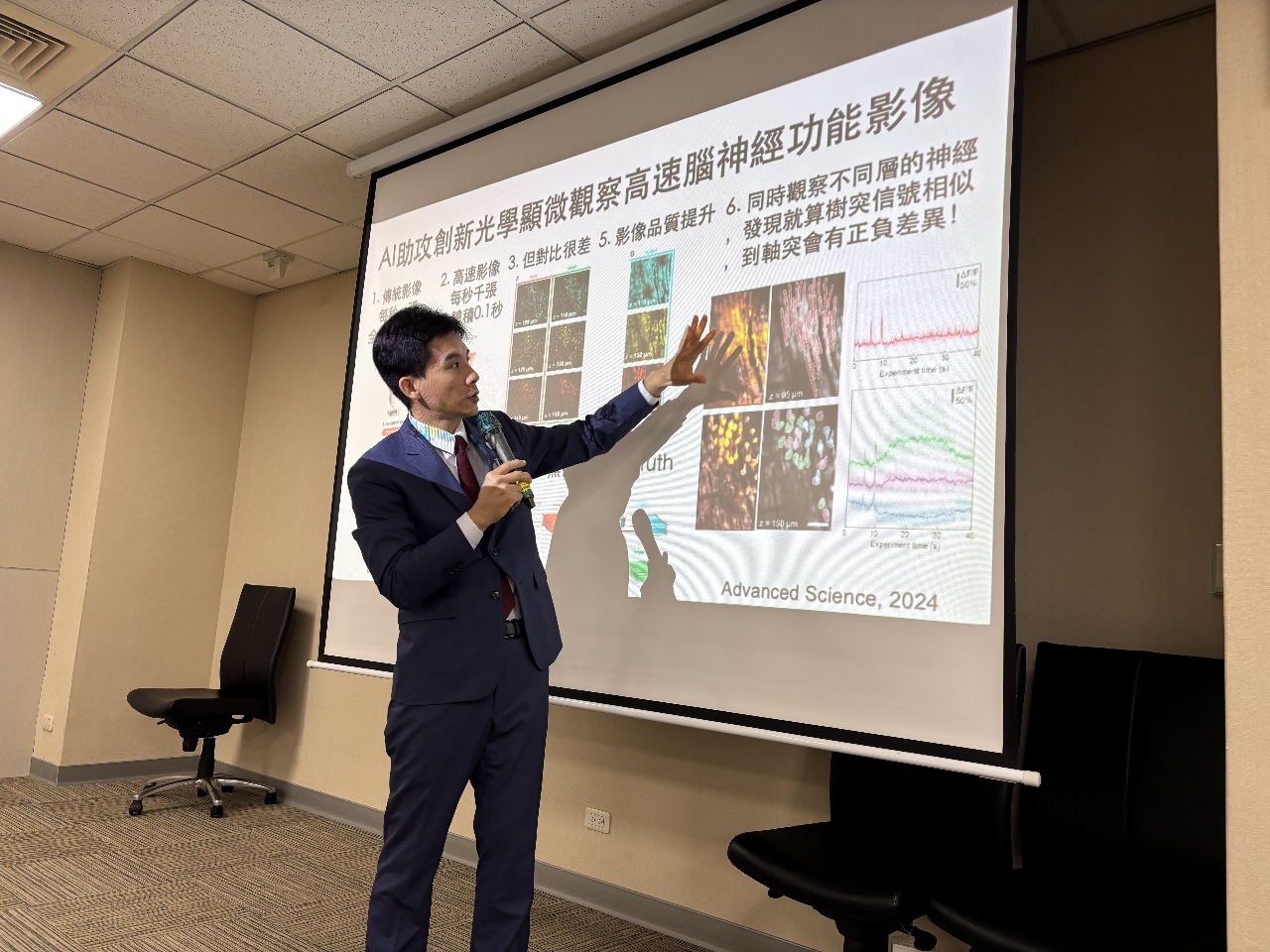
The National Science and Technology Council (NSTC) announced Tuesday that a multi-disciplinary team of researchers has successfully developed the world’s first ultra high speed 4D microscope. By integrating AI capabilities into the technology, they have managed to improve brain imaging clarity by nearly tenfold.
Led by National Taiwan University (NTU) physics professor Chu Shi-Wei (朱士維), the team includes National Tsing Hua University engineering professor Wu Shun-Chi (吳順吉), and NTU associate professor of pharmacology Pan Ming-Kai (潘明楷). Their findings, published in the acclaimed scholarly journal “Advanced Science” in November, have not only progressed brain imaging science but also breaks new ground in the field of AI.
Chu said that the 4D microscope the team developed has a scanning speed thousands of times faster than traditional microscopes, enabling the capture of neural activity in real-time. Processing the captured images through AI further improves the resolution, making it easier to see the way signals travel through the brain. He described the distribution of neurons controlling movement as similar to a computer’s GPU, explaining that they operate both independently and collectively to produce movement.
Pan said that in addition to enhancing functional understanding of neural activity, their findings also help to illuminate the way the brain itself works, which contributes to the study of diseases affecting the brain. The benefits of their research extend both ways, he said, as a deepening understanding of the nervous system aids in the development of more advanced AI.