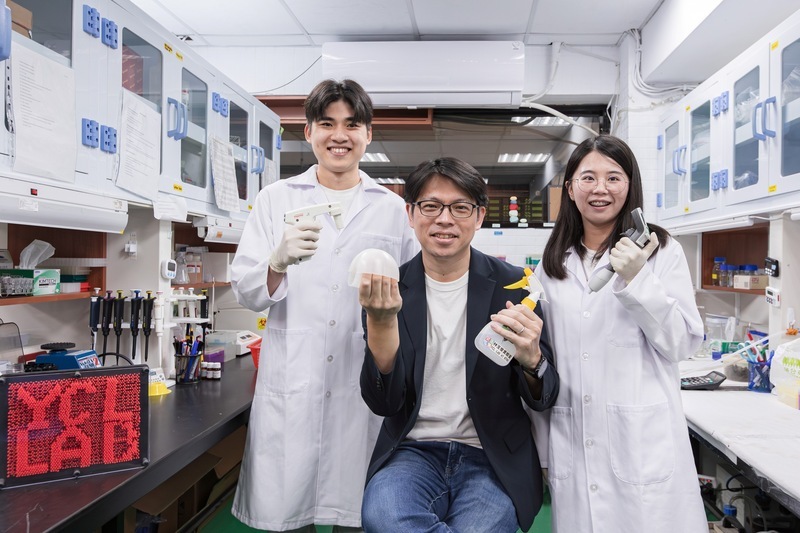
A research team led by National Tsing Hua University Professor Lin Yu-chun (林玉俊) has developed a novel “riveting” system that uses light to stop cell transport. This breakthrough could potentially control certain biological processes and have far-reaching impacts on the treatment of various diseases.
Lin explained that cells transport nutrients, hormones, and other molecules by encapsulating them in vesicles that are then moved by motor proteins along intracellular tracks. However, researchers have not been able to capture this process due to the speed at which it occurs. The RIVET system Lin’s team developed enables the immobilization of the vesicle through genetic modification and the use of blue light. Describing the research in simpler terms, Lin said that the RIVET system is like an emergency brake that can completely arrest the cellular vesicle’s movement within 15 seconds.
Notably, Lin’s research team has been able to use this technology to stop the transportation of a certain enzyme that allows coronavirus to invade human cells. Lin also pointed out that the RIVET system could also be applied to control insulin secretion, nutrient absorption, and nerve conduction. Lin’s findings have been published in the prestigious journal “Advanced Science.”