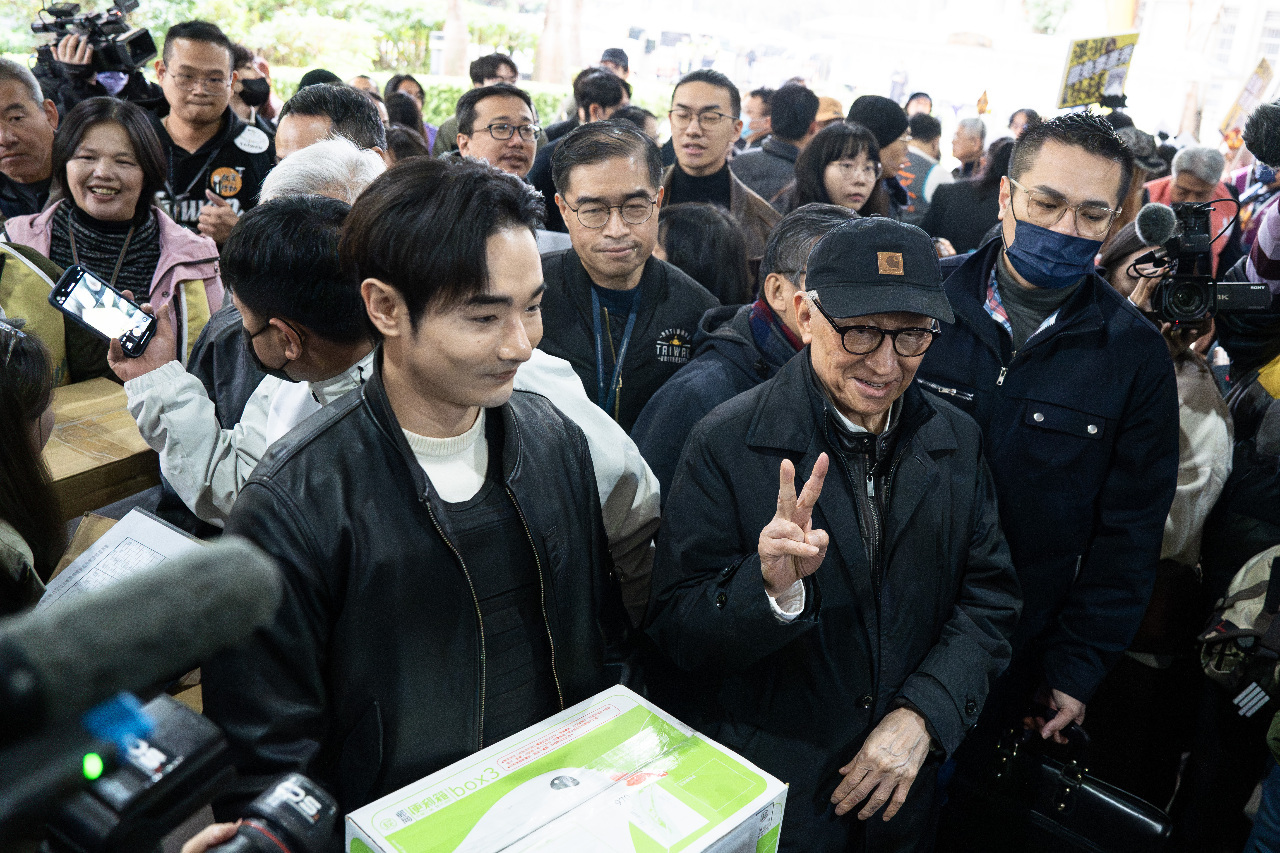
Civic groups across Taiwan have launched campaigns aimed at removing KMT legislators from their positions through recall votes. As of Monday morning, nearly 20 groups from around Taiwan– including Taitung, Hualien, Yunlin, Taichung, and beyond– have submitted their recall petitions. With slogans such as, “Recall to save Taiwan,” being shouted, UMC Founder Robert Tsao (曹興誠) and YouTube creator Pa Chiung (八炯) were among those who delivered petitions in person at Taipei’s Central Election Commission (CEC).
Tsao said that the movement to recall KMT legislators who violated the constitution and disrupted the government is a display of the will of Taiwanese citizens that transcends party affiliations. He added that the recall campaigns are not a confrontation between the KMT and DPP, but rather like democracy’s “holy war against communism and autocracy.”

Robert Tsao (front) at the Central Election Commission. (Photo: CNA)
According to Tsao, by voting and petitioning, Taiwan can show the international community the people’s determination and courage to defend its democracy and freedom, ensuring that democratic constitutionalism will not be destroyed.
When asked to respond to Tsao’s comments, former New Taipei City mayor and current KMT Chairman Eric Chu (朱立倫) responded by calling on President Lai Ching-te (賴清德) to win people over with virtue rather than force. At the KMT’s Lunar New Year celebration this Monday, Chu also claimed that the DPP has united people through the use of “fighting,” and trying to change the status quo with the recall campaigns. He noted that the KMT hopes for peace rather than fighting, and that it does not seek war, but also that it is not afraid to use war to end war when necessary.
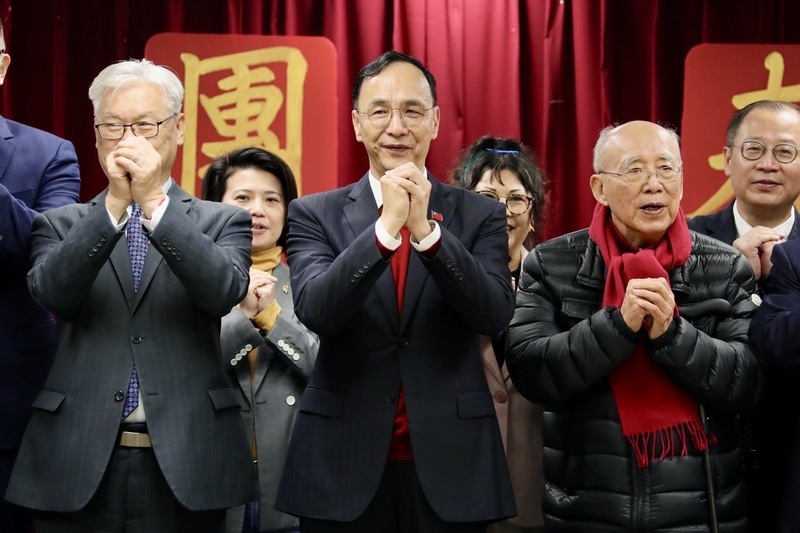
Chairman Eric Chu (center) leads the KMT in wishing everyone a happy new year at their celebration on Monday, February 3. (Photo: CNA)
Confirming that as of 10 a.m. on Monday 18 motions to recall legislators and one motion to recall a mayor had been received, the CEC reminded the public that it will uphold administrative neutrality and handle the relevant petitions in accordance with the law. They noted that qualifying submissions would be forwarded to local election committees for review.
According to the Public Officials Election and Recall Act, to pass the first stage, signatures cannot be less than 1% of the total number of voters in the electoral district where the official was elected. If passed, the threshold for the second stage requires the number of joint signers be no less than 10% of voters in the electoral district where the official was elected.