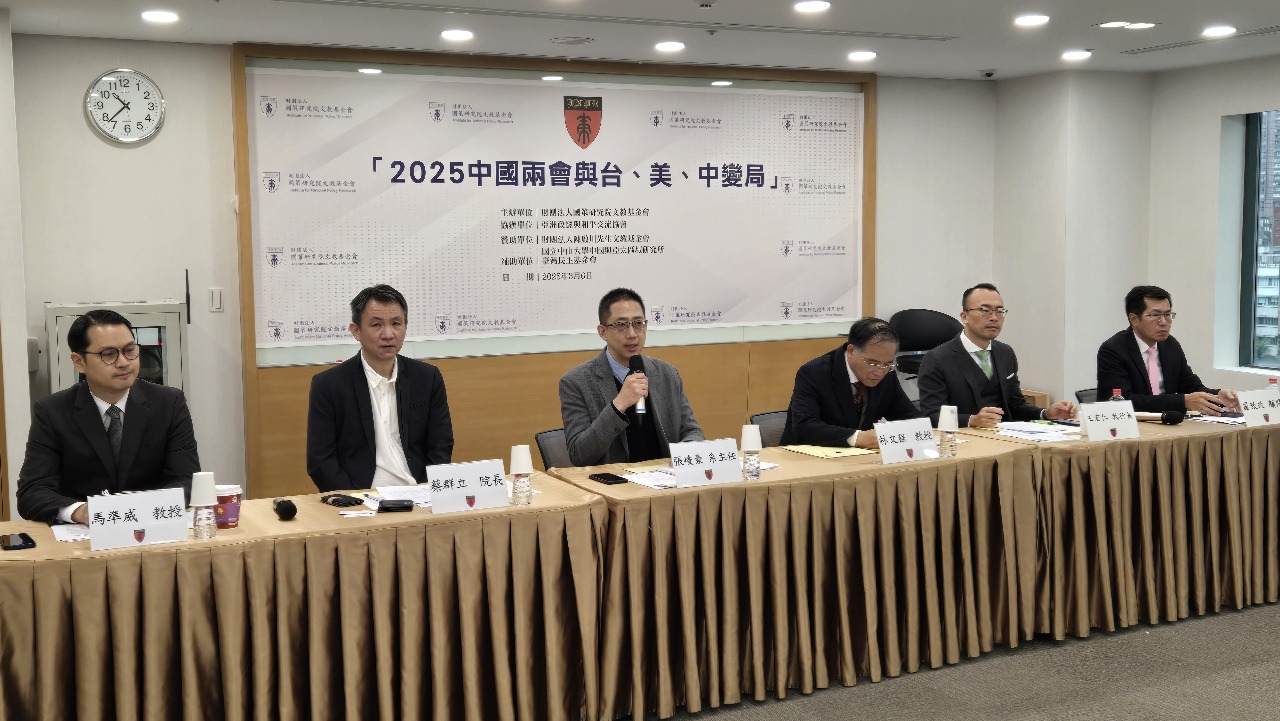
This week marks China’s annual Two Sessions meetings, a nationwide gathering where thousands of political and community delegates converge in Beijing from across mainland China, Hong Kong, and Macau. Taiwanese experts predict that the Chinese Communist Party (CCP) will escalate its anti-independence efforts toward Taiwan, shifting to strategies focused on shaping a favorable environment for its objectives.
On Thursday, the Institute for National Policy Research hosted a forum in Taipei on China’s 2025 Two Sessions and the evolving dynamics between Taiwan, China, and the U.S.. During the discussion, Director Wang Hung-jen (王宏仁) noted that changes in China’s Taiwan policy reflect its reliance on military pressure, diplomatic alliances, and international legal warfare to advance unification. He emphasized that whether the U.S. can effectively counter China’s strategy depends on the final stance of the Trump administration. Wang urged Taiwan to closely monitor U.S. policy trends, understand the Trump administration’s current priorities, and strengthen its international support network.
Tamkang University Graduate Institute of China Studies Director Chang Wu-ueh (張五岳) observed that while Chinese Premier Li Qiang’s (李强) report does not signal major shifts in Taiwan policy, there has been a clear intensification of both hardline and engagement strategies—stepping up anti-independence efforts while promoting integration and unification. As for whether significant policy changes or declarations are forthcoming, Chang said it will depend on whether Chinese President Xi Jinping (習近平) delivers a major speech on Taiwan-related issues.