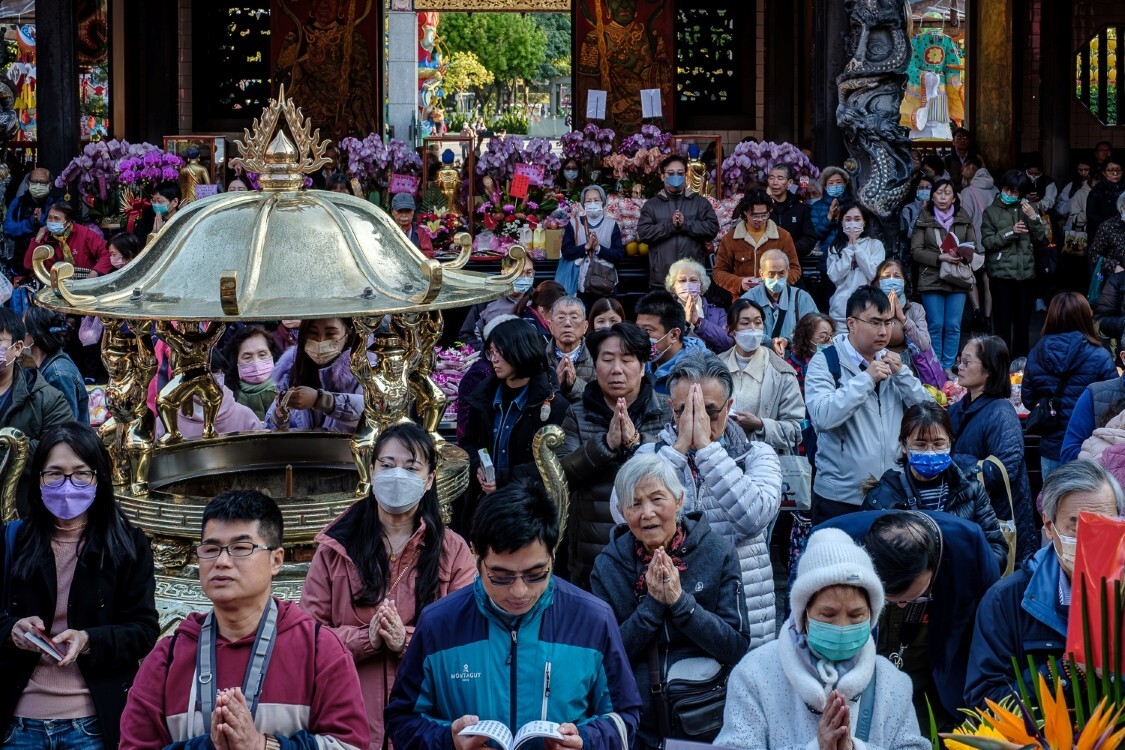
On Tuesday, March 18th, the nineteenth day of the second lunar month, Taipei’s Longshan (Lungshan) Temple held a birthday celebration for its enshrined deity, Guanyin (Kuanyin), the Goddess of Mercy and Compassion. The event included a vegetarian banquet, devotional chanting, bows and prostrations, musical performance and other ritual activities in a smoke-free surrounding of fresh air and fragrant flowers.
Conspicuously absent from the Buddhist sacred site were offerings of spirit money, the glowing light of candles and burning sticks of incense. These were banned by Longshan Temple in 2000, 2019 and 2020, respectively, in a bid to reduce pollution and prevent fires.
In spite of reports that the bans were met with significant resistance, adherents seemed to have embraced the site’s environmentally friendly policies of worshipping without smoke in a peaceful and pragmatic way. Between murmurs of ‘go green’, temple-goers prayed to deities by raising plates of food and flowers, clasping their hands together without incense, reciting incantations and dropping red divination blocks in front of altars.
They also waited patiently in line to bathe and purify objects in curls of symbolic smoke emanating from a single stick of unlit incense placed in the center of a shiny new burner and rubbed its dazzling gold figurines for blessings.
Founded in 1738, Longshan Temple is one of Taiwan’s oldest and most prominent religious institutions. For many years, the temple’s authorities held considerable sway and could influence government policy. For example, around the turn of the twentieth century they objected to the construction of a bridge and so it was moved.
Although the temple is way less powerful now, it is still an influential place of worship that can teach people to respect the environment and set a good example. One way it could continue to act on this imperative would be to phase out single use plastics and help Taiwan to become plastic free by 2030.