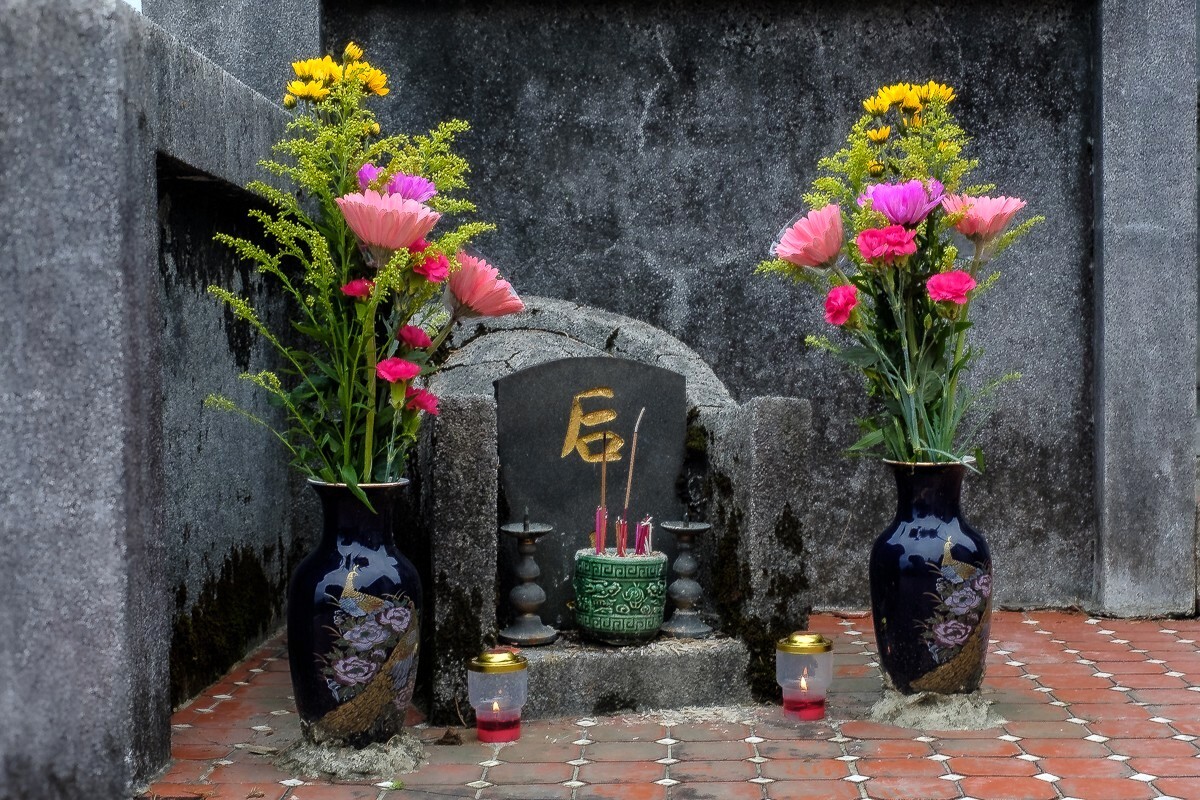
Qingming, or Tomb Sweeping Day, will be observed on and around Friday, April 4th, this year. The festival of general mourning includes visits to ancestral tombs and meals with family as well as outdoor activities with friends on the day itself and on the days before and after.
Daytime rituals performed to honor those departed and invoke blessings include placing fresh colorful rectangular clusters of paper on the grave that are held in place with stones and appear like shingles on a house. Another graveside rite includes making offerings of flowers, candles and incense, among other sacrifices, to a once powerful spirit called Houtu.
Revered as a guardian, Houtu can be propitiated for protecting the earth that was disturbed by the digging of the grave and preserving the integrity of the grave. The divinity is also believed to bring peace and intercede positively in people’s lives supernaturally.
Houtu is similar to but different from the earth deity Tudigong. One difference is that Houtu is traditionally featured as a written name on a stone that also functions as a boundary marker. In the past, when Houtu was represented by an image rather than an inscription, the figure also tended to be personified as female rather than an elderly male.
Nowadays, many stone markers inscribed with Houtu still remain. Perhaps it should come as no surprise, however, that it is more likely to replace Houtu with the dominant male figure of Tudigong than a goddess as the guardian of the grave.