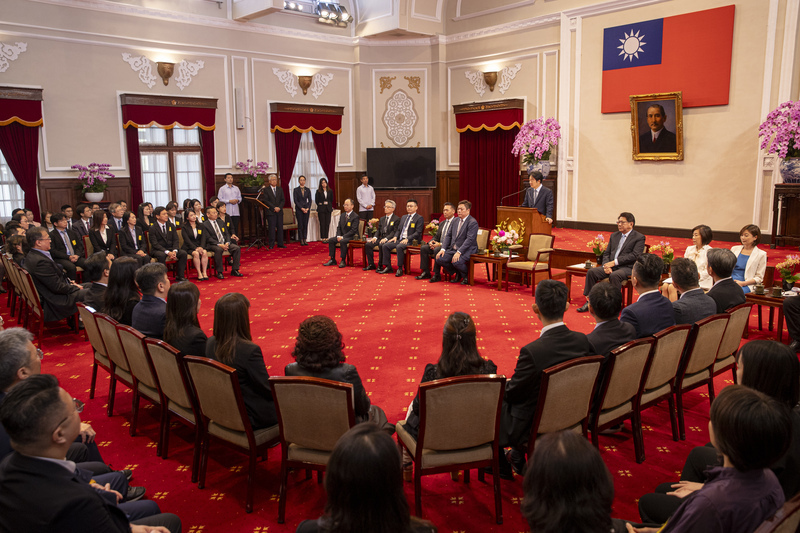
On Monday, President Lai Ching-te (賴清德) met with alumni associations from three departments of the Taipei University of Technology, where he spoke about the central government’s plans to deal with an ever-changing global situation and the need for proper funding.
Lai highlighted the rapidly changing situation with tariffs and the resulting global trade wars, saying Taiwan must work carefully to turn such crises into opportunities. He said that Taiwan’s government has already begun negotiations with the U.S. with the goals of transforming Taiwan’s economy, safeguarding industrial development, and protecting national interests.
He also mentioned his administration’s past efforts to improve and protect Taiwan’s investment environment, including trade memoranda and domestic policy planning. He expressed his hope that Taiwan can resolve trade barriers through bilateral or multilateral efforts to allow Taiwanese products to be marketed around the world.
Lai also pointed to Taiwan’s growing stock market and concert economy as proof of Taiwan's recent strong performance, resulting in good tax revenues. He continued that the government plans to reinvest that revenue back into assistance for small and medium enterprises, developing the national defense industry and societal investments. He highlighted policies like state support for children aged zero to six, free tuition for vocational and high schools, and university tuition subsidies.
Referencing the planned NT$88 billion (US$2.7 billion) post-tariff subsidy plan, he underscored the central government’s need for the resources which “give the government enough power [to] take care of the people”.
His comments come in reference to the recent amendments harshly slashing the central government’s budget while significantly reallocating funds to local governments. Lai’s administration has maintained that many policies cannot be fully implemented without reinstatement of the previous budget. With the Cabinet’s review motion for the amendments rejected in the Legislature last month, the Cabinet is currently weighing whether to file for a constitutional interpretation on the matter.