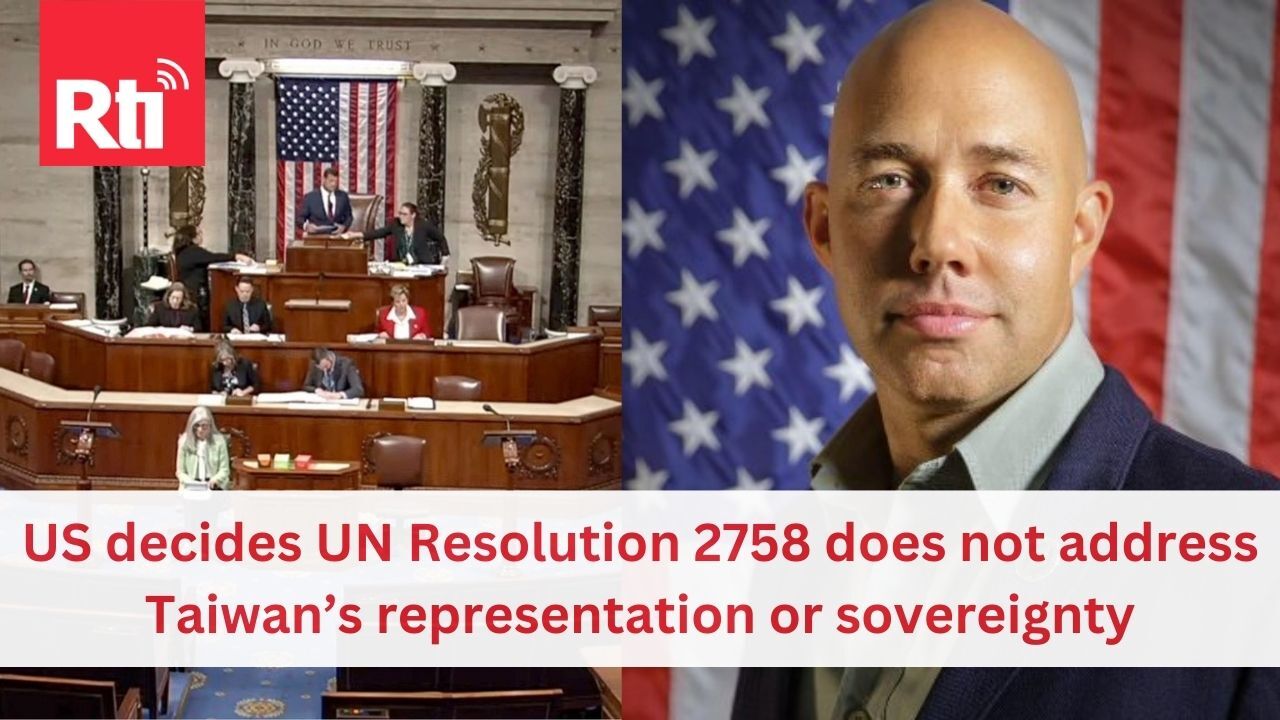
Amid rising U.S.-China tensions and heightened concern over the Taiwan Strait, the passage of these pro-Taiwan bills by the U.S. Congress signals strong bipartisan support for Taiwan.
Video script:
The U.S. House of Representatives recently passed two major pro-Taiwan bills by unanimous consent: the Taiwan International Solidarity Act and the Taiwan Assurance Implementation Act. These bills mark a significant step from bipartisan consensus to concrete action in Washington’s Taiwan policy, underscoring Taiwan’s role in the international system and openly opposing Beijing’s political efforts to isolate the island.
The Taiwan International Solidarity Act is considered an upgrade to the 2020 Taipei Act. It clarifies that UN General Assembly Resolution 2758 solely concerns China’s representation at the UN and does not address Taiwan’s representation or sovereignty. In other words, Beijing’s interpretation of the resolution is a unilateral political move, not grounded in international law or the original intent of the UN.
The bill requires the U.S. government to use its voice, vote, and influence in international organizations to defend Taiwan’s right to participate and counter China's distortion of UN resolutions and norms. It also encourages U.S. allies and partners to speak out when appropriate against China’s diplomatic pressure tactics aimed at severing Taiwan’s formal and informal international ties.
House Foreign Affairs Committee Chair Brian Mast warned that Beijing is systematically attempting to marginalize Taiwan on the global stage. Mast emphasized that China’s misinterpretation of Resolution 2758 is part of a broader attempt to rewrite global rules.
The House also passed the Taiwan Assurance Implementation Act, which enhances substantive U.S.-Taiwan engagement. Building on the 2020 Taiwan Assurance Act, it authorizes the State Department to regularly review its internal guidelines on interactions with Taiwan and report to Congress on progress in lifting self-imposed restrictions.
Since the severing of official diplomatic ties in 1979, the U.S. State Department had imposed internal restrictions on interactions with Taiwanese officials. Although then-Secretary of State Mike Pompeo scrapped all such restrictions in January 2021, the Biden administration reinstated the guidelines – albeit with greater flexibility, allowing officials to meet Taiwanese counterparts both in U.S. federal buildings and at Taiwan’s representative office.
According to CNA on May 6, scholars believe the new legislation significantly increases the likelihood of senior Taiwanese officials – such as the National Security Council Secretary-General, Foreign Minister, and Defense Minister – visiting Washington. Kuo Yu-jen (郭育仁), director of National Sun Yat-sen University’s Institute of Asia-Pacific Affairs, noted that the delay in fully lifting restrictions was due to the U.S. retaining leverage with China. Passage of the bill, however, will grant Washington greater flexibility.
By codifying these policies, the U.S. ensures greater consistency and durability in its Taiwan policy. Chen Shih-min (陳世民), associate professor of political science at National Taiwan University, emphasized that once legislated, the level of official interaction cannot be arbitrarily adjusted without further amendments – marking a shift toward more institutionalized U.S.-Taiwan cooperation.
In a significant move to bolster Taiwan’s international presence, the Taiwan International Solidarity Act explicitly affirms that United Nations Resolution 2758 does not apply to Taiwan. The legislation also directs the United States to actively challenge Beijing’s narrative on the global stage. Chen says the bill will enhance Washington’s ability to support Taiwan diplomatically. As China continues to pressure governments into endorsing its "one-China" principle, the U.S. is now expected to take a leading role in uniting Western democracies in defense of Taiwan’s international standing.
Kuo added that China’s aggressive “lawfare” in recent years has already prompted the U.S. to begin its response. This legislation represents a shift from consensus to concrete action. Both scholars agree that the U.S. is not only strengthening its substantive relationship with Taiwan but also demonstrating resolve on the world stage to push back against authoritarian expansion from China.
The bills still require Senate approval and presidential signature before taking effect. Amid rising U.S.-China tensions and heightened concern over the Taiwan Strait, the passage of these pro-Taiwan bills by the U.S. Congress signals strong bipartisan support for Taiwan. This development stands as both a firm rebuke of China’s efforts to limit Taiwan’s international space and a clear endorsement of Taiwan’s democratic values and institutions.