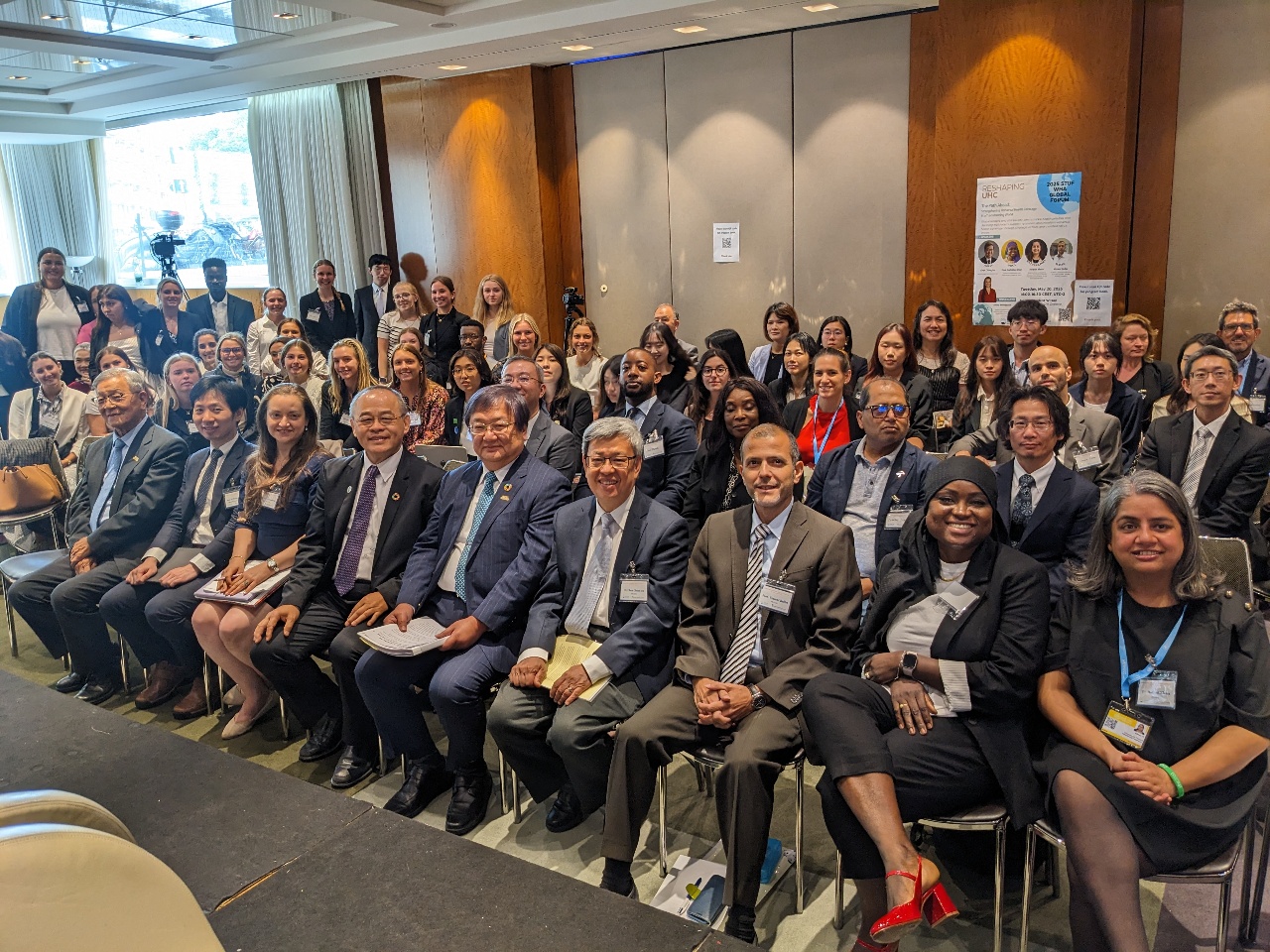
Although Taiwan cannot directly participate in the World Health Assembly (WHA), official and civil society representatives continue to organize international forums on the sidelines. Former Vice President Chen Chien-jen (陳建仁) served as a featured speaker at a forum hosted by the World Taiwan Foundation, where he introduced Taiwan’s National Health Insurance (NHI) system and received enthusiastic responses from attendees who posed various questions about the program’s implementation.
The forum, co-hosted by the World Taiwan Foundation and the Global Health Council (GHC), focused on universal health coverage (UHC). European professor Vincent Rollet, who has taught at Taiwan's Wenzao Ursuline University of Languages for many years, opened the discussion by sharing the EU's healthcare coverage situation. He noted significant disparities among member states, with countries like Malta, Portugal, and Bulgaria requiring patients to pay high costs out-of-pocket, while Sweden and Ireland have less than 2% of households facing such financial burdens.
In contrast, Chen highlighted that the NHI system, now entering its 30th year, has achieved a coverage rate of 99.9%. International attendees, including Dr. Sarah Onyango from Population Services International, a nonprofit organization dedicated to improving health in developing countries, were particularly impressed with Taiwan's experience. She praised Taiwan's model as worthy of emulation by African nations, noting how Taiwan's system protects people of different income levels and prevents medical expenses from pushing families into extreme poverty.
Chen underscored the vital role of Taiwan's civil society in developing its health insurance system. In the early 1990s, as Taiwan became a democracy, citizens, including workers, farmers, and fishermen, demanded a national medical insurance system. Before 1995, less than 60% of the population was covered by 13 different social insurance schemes. Strong public advocacy led to a comprehensive system that now covers nearly 100% of residents.