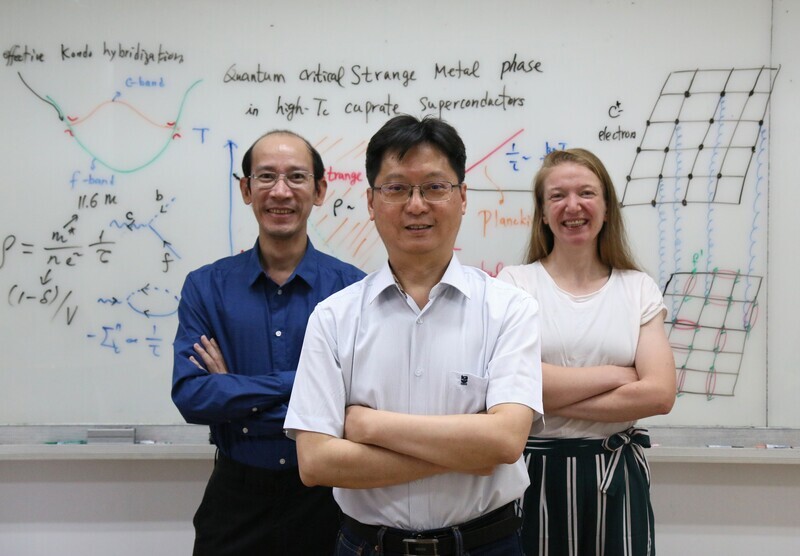
A Taiwanese research team has been featured in Reports on Progress in Physics, a leading international journal published by the UK’s Institute of Physics. Their study was not only selected as a featured article but also ranked among the most-read papers on the platform.
For decades, scientists have pursued superconductors capable of carrying electric current with zero resistance and no energy loss. Now, a team led by Professor Chung Chung-hou (仲崇厚) from the Department of Electrophysics at National Yang Ming Chiao Tung University has successfully uncovered the formation mechanism of the “strange metal” quantum critical state in cuprates — a mysterious phase believed to precede high-temperature superconductivity.
In ordinary metals, electrons collide and generate resistance, causing energy loss. Superconductors, by contrast, display zero resistance and perfect diamagnetism, virtually eliminating energy waste. However, this state only occurs below a material’s critical superconducting temperature. Scientists have therefore focused on raising this threshold, aiming to find materials that exhibit superconductivity at room temperature and ambient pressure.
Chung worked with Kim Remund, Yung-Yeh Chang, and Khoe Van Nguyen to complete the paper. Chung emphasized that this breakthrough is the result of fully independent domestic research and has received considerable international attention.