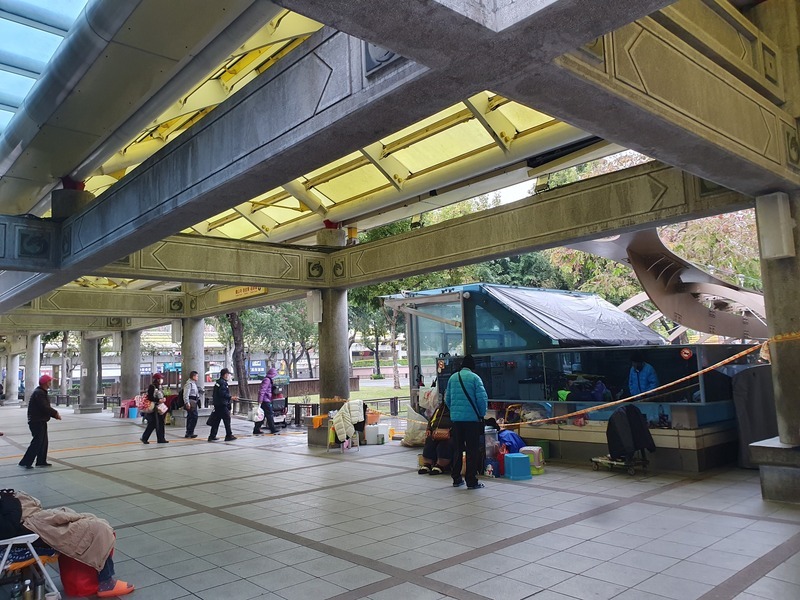
Reconstruction efforts around Monga Park (艋舺公園) have triggered a controversy around the forced resettlement of homeless people, driving civil advocacy groups to demand that the government enact a homeless protection law quickly.
Taipei’s Monga Park, located in the Wanhua district, is soon to be renovated. The park itself is well-known not only as a gathering place for visitors to Lungshan Temple, but also as a place for homeless people to stay. The new project would force these people to relocate without offering any support network or suggestions for where they should go, in what one advocate called the largest social exclusion event in Taipei City’s history.
Advocacy groups, including Do You A Flavor and the Homeless Taiwan Association, held a press conference on Monday calling for the government to establish a complete resettlement package, including a homeless protection act, to ensure the human rights of those who would be forcibly resettled. Do You A Flavor Co-Founder Ader Wu (巫彥德) said the renovation project only removes unhoused people without establishing a self-reliance mechanism to help people back into society. He emphasized that the project should be cross-departmental and multi-level, involving the central government and local mayoral levels to provide the most effective and suitable allocation of resources and care.
Wu pointed to the Japanese government’s implementation of self-reliance support acts as an example. Implemented in 2020, the projects are credited with reducing homelessness in the country by nearly 80%. He said if Taiwan can learn from this project, formulating a clear legal framework for those in need and clearly defined self-reliance goals, it would be the best framework for long-term and effective policy.
Homeless Taiwan Association Secretary-General Lee Ying-tzu (李盈姿) supported Wu’s claims by saying that, based on her own experience accumulated in Wanhua, immediate local and convenient services are the most effective means to support self-reliance and re-establishment. She also called on the central government to use this renovation as an opportunity to address institutional shortcomings and establish a national mechanism with clear goals and interdepartmental collaboration to support the homeless with real policy.