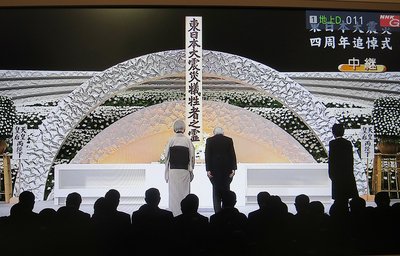
A memorial event was held in Taipei’s Ambassador Hotel on Wednesday to mark the 4th anniversary of Japan's Fukushima disaster.
Legislature President Wang Jin-pyng and the head of the Japan Interchange Association in Taipei, Numata Mikio, attended the event along with other officials.
Numata said that Taiwan is an important partner to Japan and expressed gratitude for the help that Taiwan gave to the victims. Taiwan gave about US$260 million in disaster relief to Japan, the most of any country.
The Japanese government also held a memorial ceremony at Tokyo's national theater and Taiwan's representative to Japan Shen Ssu-tsun was in attendence. Shen represented the people and government of Taiwan in giving condolences to Japan. In a press release, Shen also said that Taiwan and Japan will continue to work together on disaster prevention and reconstruction.
Taiwan’s Red Cross Society has also done much reconstruction work for the victims of the disaster. In the wake of the disaster, Taiwan’s Red Cross Society received over NT$2.5 billion (over US$80 million) in donations. The Red Cross said Wednesday that 99.86% of its reconstruction work in Japan has already begun.
Taiwan’s Red Cross Society Chairwoman Wang Ching-feng spoke with RTI about the reconstruction work. "We spent the largest amount, 2.2 billion yen (US$18 million) on the hospital in Minamisanriku, Miyagi prefecture," Wang said.
"The elderly make up 40% of the population there. About 40% of the funds were used to begin construction last July, and the building should be completed in October and opened in December. There is also more public housing that will be finished later because it is difficult to find land, so it will probably be completed in 2017."
Reconstruction in Iwate prefecture has been slower because the area suffered especially severe damage. Over 29,000 people there are still living in prefabricated housing.
Besides reconstruction work, Wang said that Taiwan’s Red Cross is also trying to strengthen the morale of local people by organizing events such as walkathons, concerts, and celebrations of traditional festivals.