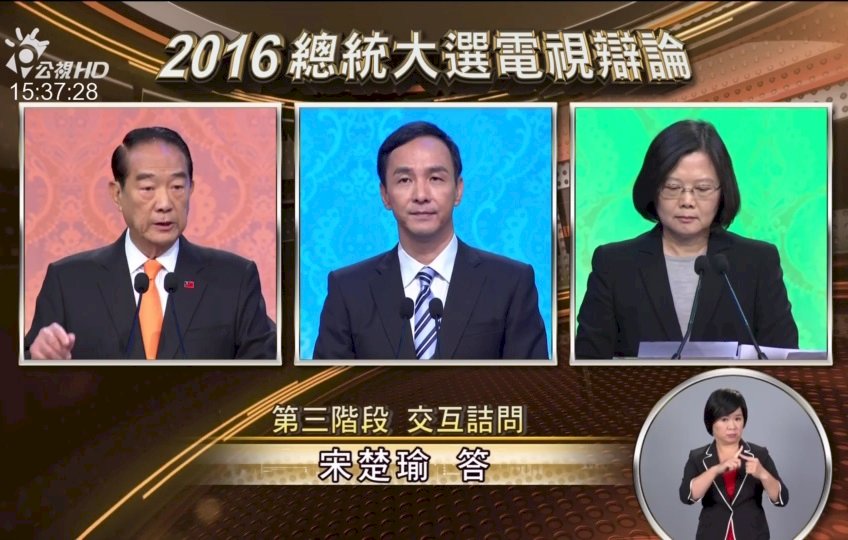
Taiwan’s three presidential candidates faced off in their first televised debate on Sunday, with less than four weeks remaining before the January 16 elections.
The three candidates – the Kuomintang’s (KMT) Eric Chu, the Democratic Progressive Party’s (DPP) Tsai Ing-wen, and the People First Party’s (PFP) James Soong – each spoke about their economic and industrial policies.
Chu said that for the past eight years, his party has taken the right approach to governing Taiwan. However, he said there were areas in which improvement was needed, and he apologized for that. Chu, who is chairman of the KMT, said that his party would make a greater effort to push for reforms in the future. He listed three strategies, including lifting the minimum wage from NT$20,008 per month, to NT$30,000. That’s an increase from the current minimum wage of about US$600 to about US$900 per month. Other strategies included lessening the gap between rich and poor, and focusing on consensus building. Chu said that he would increase taxes for the rich and decrease taxes for the middle class.
Meanwhile, DPP Chairwoman Tsai Ing-wen was on the offensive from the outset, criticizing Chu and the ruling party of being overly satisfied with their efforts during the current administration. She said the party had a disconnect with the general public. She also criticized Chu’s policies for helping Taiwan’s industries compete and work with China’s so-called “red supply chain”. Tsai said that those policies would only tie Taiwan’s economy even more closely to China’s economy. She said she suspected that it would be a continuation of the current administration’s policies, which she said were incapable of saving Taiwan’s economy.
The third candidate – PFP Chairman James Soong – spoke about his policies for enabling Taiwan’s economy to grow faster than South Korea’s and be on par with Singapore’s by the year 2030. In doing so, he gave specific goals for economic growth and the debt ratio. Soong also pledged to focus on the green energy industry, increasing internet speed, and boosting economic cooperation with Southeast Asian nations.