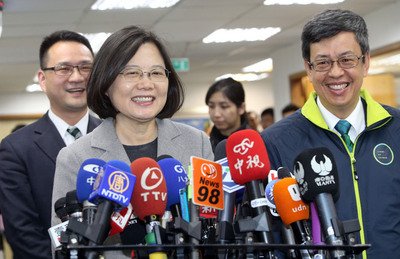
President-elect Tsai Ing-wen spoke publicly on cross-strait affairs Wednesday for the first time since Election Day.
Zhou Zhihuai, the head of the Chinese Academy of Social Sciences, Institute of Taiwan, has said that if Tsai does not recognize the 1992 Consensus, China will gradually stop certain cross-strait exchanges starting May 20, the day Tsai is inaugurated. Zhou says he believes Tsai’s victory speech displayed more animosity towards the Mainland than a desire to communicate. He said it was hard to be optimistic about Tsai’s cross-strait policy.
But Tsai said those were only Mr. Zhou’s thoughts. She responded to these remarks at a meeting of the DPP’s central standing committee.
"I think that both sides have had interaction that seems pretty good," said Tsai. "We will deal with these things very carefully."
Meanwhile, in the US, DPP Secretary-General Joseph Wu says that maintaining cross-strait peace is in his party’s interest. Wu was speaking Tuesday to prominent Washington think tanks.
The 1992 Consensus was a big topic in the elections. Under the consensus, Taiwan and China agree that both sides are part of “One China” while maintaining separate interpretations of what “One China” means. Wu said that President-elect Tsai Ing-wen would like to go back to the 1992 spirit of the two sides putting aside differences and finding commonalities.
He said the DPP will pursue a policy of cross-strait interaction in which the both sides can accept one another, avoiding conflicts and surprises. Wu said that passing a bill to monitor cross-strait agreements is a priority, and that cross-strait peace is in the DPP’s interests.
The KMT, which lost the election, is generally regarded as leaning towards China, whereas the DPP is viewed as being wary of China. But Wu also said that people should not interpret the election as a vote against China. He said that cross-strait relations were not the major issue in the election.
He also said that the DPP wants to work together with the KMT and other parties in the legislature to help Taiwan enter the Trans-Pacific Partnership (TPP) and reform the economy.