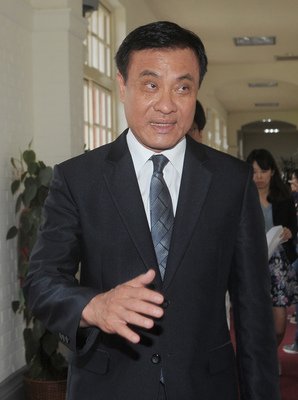
Legislature President Su Jia-chyuan spoke on Monday about how a trip to China by eight opposition party affiliated officials could have a negative impact on Taiwan.
He was referring to a delegation of eight city and county government leaders from Taiwan who met with Beijing officials on Sunday. Six of the officials are from the opposition Kuomintang, while the other two are affiliated independents. All acknowledged the so-called “1992 Consensus” prior to making the trip to Beijing to seek ways of “resetting and restarting” cross-strait ties.
Under the “1992 Consensus”, the two parties recognize the existence of “one China”, with each side allowed its own interpretation of what that means. That consensus formed the basis of cross-strait dialogue under the previous administration. Analysts say President Tsai Ing-wen’s failure to acknowledge the consensus has led to a perceived boycott from Beijing.
In an interview on Sunday, Su was critical of China’s insistence on the “1992 Consensus” as a bargaining chip for talks.
“‘If you acknowledge [the consensus] then we’ll open up something or give you something’, that’s not normal. I think any country should have democratic qualities, but democracy should not be used as a tool, or business consideration, that’s not fair to the people," said Su.
Su said that it’s normal in a democratic country like Taiwan to have different opinions, like some hoping that the country can become independent, and others hoping Taiwan can become part of China. He said that if democracy becomes a tool for doing business, then it would not be good for the country, and could even bring about negative effects. Su urged the people of Taiwan to think carefully about that issue.