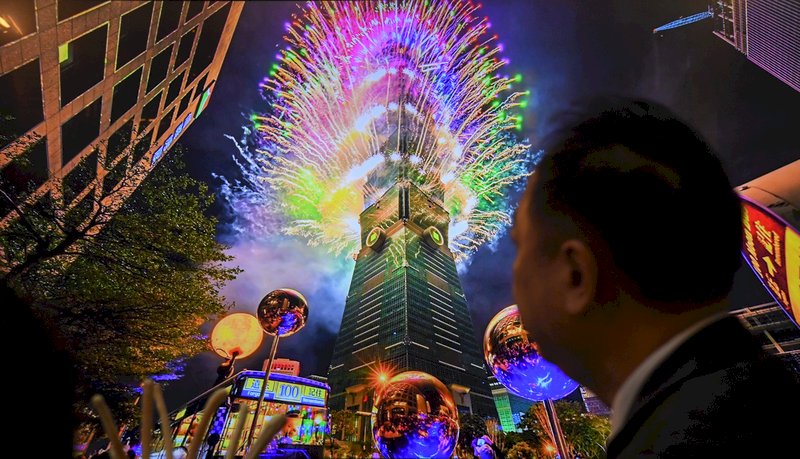
On Friday night, people all over the world rang in the New Year with celebrations. Many major cities and countries saw their celebrations severely scaled down due to the rapid spread of the Omicron variant of COVID-19. Taiwan however enjoyed relatively normal New Year’s celebrations thanks to its strict, effective, pandemic prevention policies.
One of the biggest parts of any New Year’s Eve celebration is of course the fireworks. This year was no exception with firework parties in Taoyuan, Nantou, Yunlin, Kaohsiung and other cities all around Taiwan. For example, Taipei 101’s firework display fired off 16,000 fireworks over 360 seconds and New Taipei’s fireworks across Tamsui river lasted 13 minutes and 14 seconds.
But what are the environmental impacts of these events? Fireworks often contain oxidising chemicals that help produce the explosion. These chemicals then dissolve in water and can contaminate rivers and lakes, leading to issues for the natural environment as well as drinking water supplies. They also contain things such as copper, barium and strontium compounds to give them their distinctive colour. All of these chemicals use large amounts of energy to be produced to then be blown into the sky for a brief moment in time. They also produce large quantities of particulate matter that pollute the environment. According to the European Union’s Environmental Agency, 75 percent of the yearly fine dust pollution from fireworks is generated just on New Year’s’ Eve.
It’s not only New Year’s Eve that Taiwan has mass firework displays either. In February or March every year during the Lantern Festival, Tainan’s Yanshui district also celebrates a ‘Beehive Fireworks Festival’. This folk celebration sees hundreds of thousands of firecrackers being released at the same time to mimic bees coming out of their hives together. The offshore island county of Pengu also hosts an annual Firework Festival that takes place over the course of two months in summer.
In a world where environmental consciousness is becoming more and more important, fireworks are slowly going out of fashion. For example, in 2015 the Mayor of Taiwan’s largest central city Taichung cancelled the fireworks portion of the city’s New Year’s Eve event due to particularly high levels of pollution that year. In 2017, the number of fireworks released from Taipei 101 were cut down from 30,000 to 16,000 due to pollution concerns, but they were complemented with an LED show to make up for it.
A more eco-friendly alternative to fireworks that has been growing in popularity in recent years is drone light shows. Drones are reusable, don’t emit any pollutants and can be programmed to create amazing visual effects in the sky. Of course, they also don’t have the huge noise impact that fireworks do and so don’t terrify wildlife. Drones have featured in many different global New Years’ Eve events already, including in London, Melbourne, Hong Kong and Dubai.
Drones aren’t as easily accessible as fireworks. But for a celebration as big as New Year’s Eve in a major city it makes sense that local governments and sponsors would be able to find the companies with the necessary skills, permits and supplies to pull off a light show.
The final chapter of this year’s Taipei 101 fireworks was about looking towards a better future. The question is whether this future will be one where we still send harmful fireworks into the environment every year, or one where we have no choice but to look for better alternatives. Nothing can quite compare to the wonder of seeing a night sky light up by brightly coloured fireworks. There is however a degree of recklessness, and questions do have to be asked about whether they’re worth their climate impact. There’s no doubt that fireworks will still be a staple of Taiwan’s New Year’s Eve celebrations for years to come, but perhaps fireworks are past their prime and it’s time to leave them behind, fizzling off into the night skies of yesteryear.